


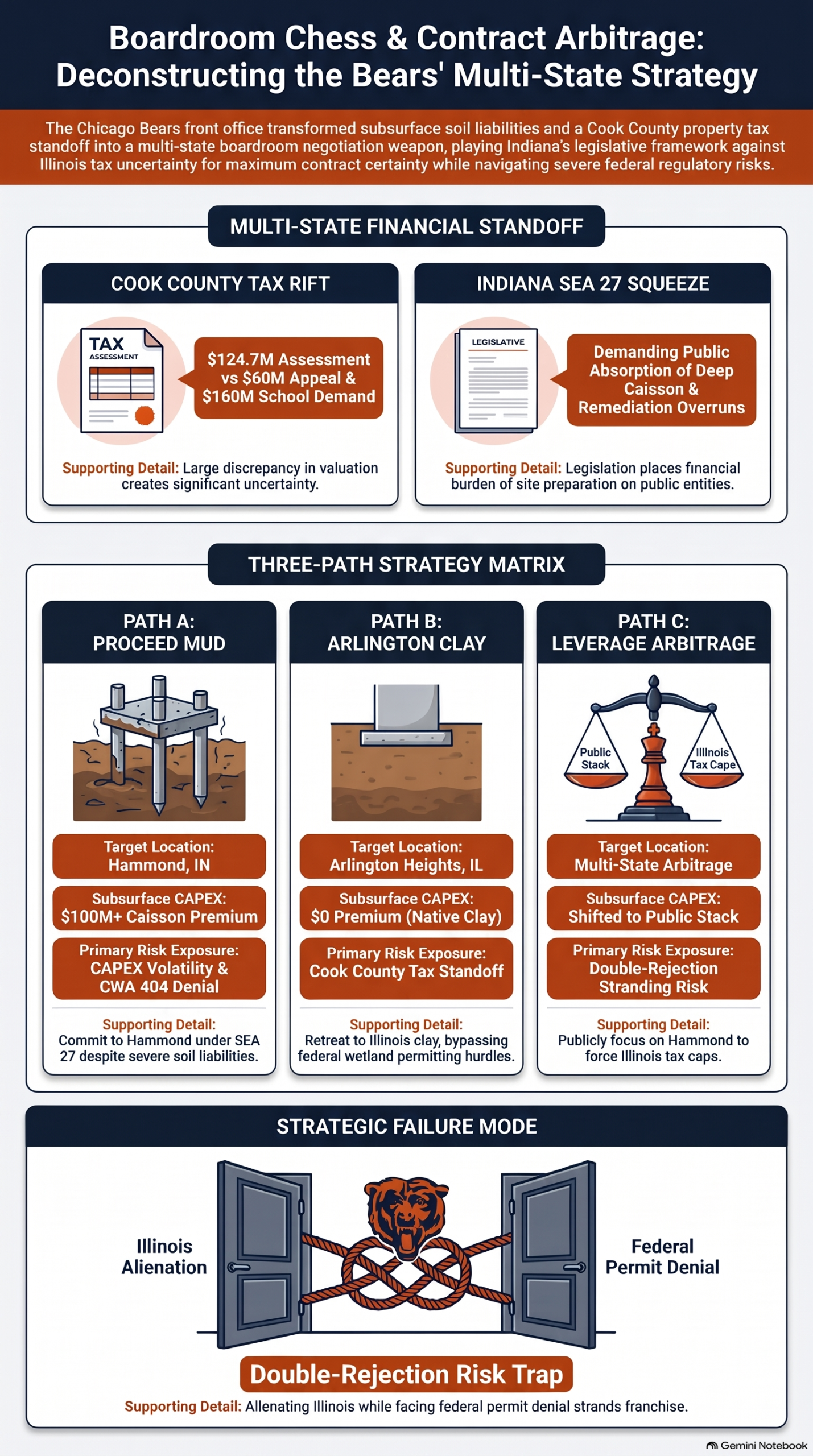
Groundwork & Gridlock · The Boardroom Chess Match
The Boardroom Chess Match: How a Tax Bill Turned Into a Two-State Standoff
It started with a property tax fight in Arlington Heights. Indiana answered with a $1 billion package. Now Illinois has one more move to make before Dec. 3.

Choose your format
READ
The article · [X] min
SEE
Full-size infographic · free download
LISTEN · WATCH
Podcast + video with Steph & Matt
THE RESEARCH
Slide deck + full report · skip ahead
The speed, the dirt and the regulators are all on the table. This is the part where the front office decides what to do with them.
It started with a property tax bill. It’s ending, one way or another, in Springfield.
STATUS CHECK · AS OF NOV. 8, 2026
Illinois hasn’t passed a stadium bill, and no final bill text is public. The Bears are still doing due diligence on two Wolf Lake-area sites in Hammond. Illinois’ veto session runs Nov. 17–19 and Dec. 1–3.
$124.7M
Arlington Park value set by the Cook County Board of Review
$39M+
Yearly savings the Cook County Treasurer’s office pinned on the megaprojects bill
37–17
Senate vote for the stadium-authority bill. The House never voted
DEC. 3
Last scheduled day of Illinois’ veto session
Where the border war started
The Bears closed on the 326-acre Arlington Park site in 2023 for $197.2 million. Then the tax fight began. The Cook County Assessor reset the land at about $197 million, close to six times its $33.5 million value as a racetrack. The Cook County Board of Review cut that to $124.7 million, still enough for an $8.9 million tax bill. The Bears appealed, asking for $60 million, which would mean a bill of about $1.7 million.
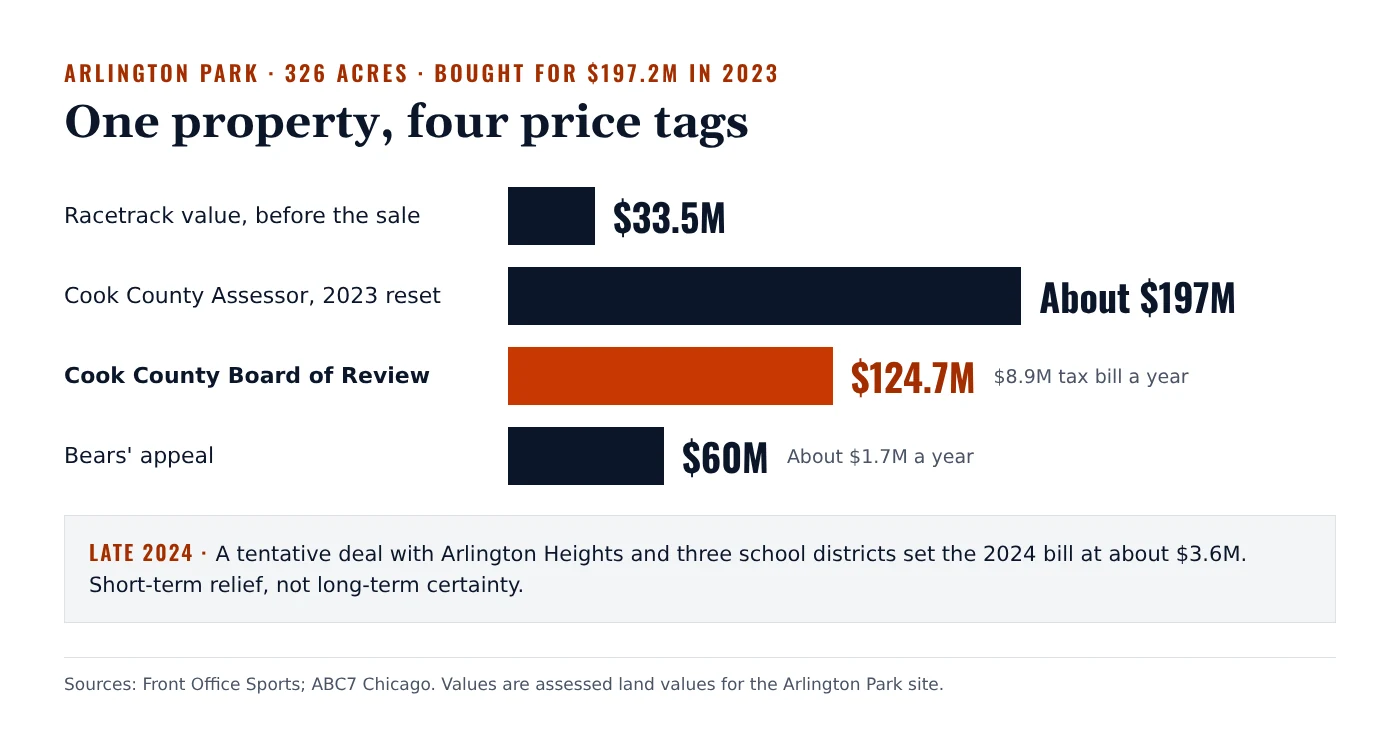
A tentative deal with the village and three school districts in late 2024 eased the short-term bill to about $3.6 million. But a holding-pattern deal isn’t long-term certainty for a $5 billion stadium district. That’s what the team said it needed, and Springfield didn’t deliver it.
| WHO | VALUE | TAX BILL |
|---|---|---|
| Racetrack value, before the sale | $33.5M | — |
| Cook County Assessor (2023) | About $197M | — |
| Cook County Board of Review | $124.7M | $8.9M a year |
| Bears’ appeal | $60M | About $1.7M a year |
| Late-2024 tentative deal | — | About $3.6M (2024) |
Illinois' counter-moves
Springfield did try. On April 22, the House passed a “megaprojects” bill 78–32 that would have let the Bears lock in their property taxes for decades. The Cook County Treasurer’s office put the savings at more than $39 million a year on a new stadium, and over $1.5 billion across 40 years. The bill died in the Senate. Senate President Don Harmon’s verdict: “There was no appetite at all to provide public dollars to a $10 billion sports franchise.”
Hours later, the Senate passed a different idea, 37–17: let a town create a stadium authority that owns the building. Sen. Bill Cunningham, who said it was modeled on Indiana’s Northwest Indiana authority, summed up the logic in one line: “As we know, publicly owned buildings do not pay property taxes.” The House adjourned without voting on it.
That idea is back. As described this fall, Arlington Heights or Chicago would create the authority, the Bears would pay to build the stadium and public money would go to roads and infrastructure. Gov. JB Pritzker wants the bill ready during the first veto week, “and then hopefully get voted on during the second week of veto.” No bill text is public yet.
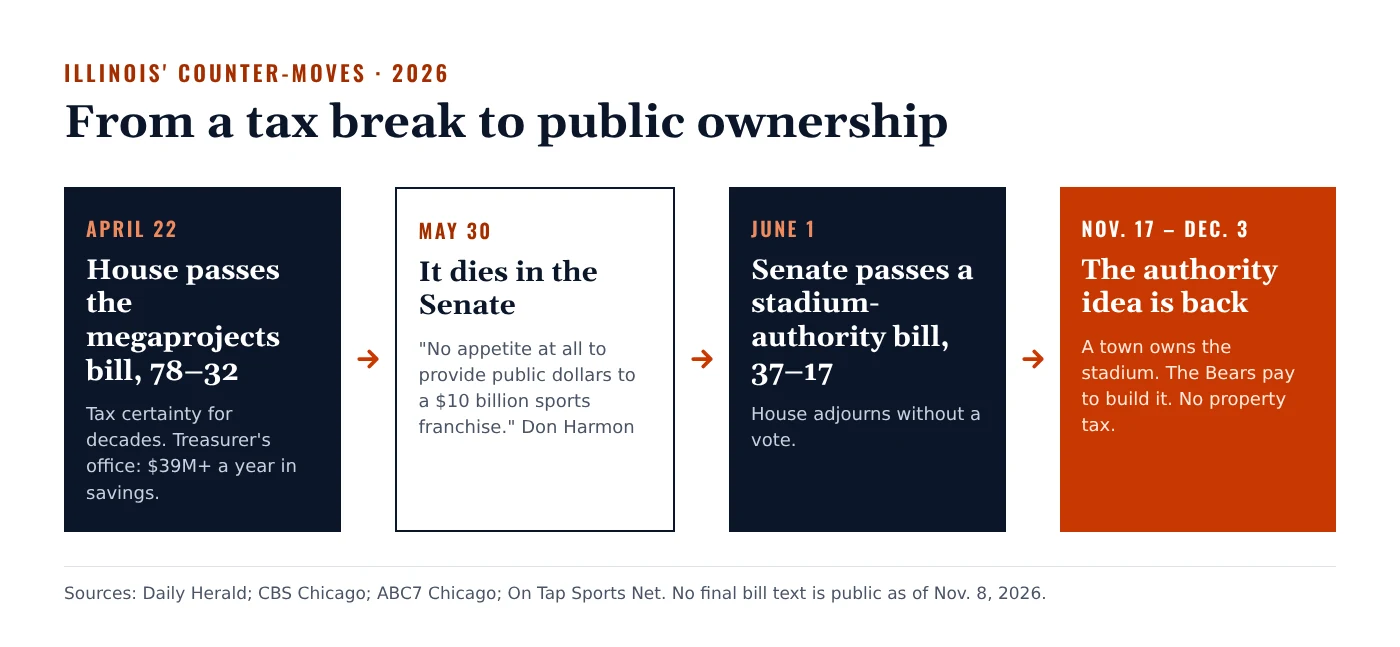
Leverage only works while both doors are still open.
Three paths, updated
The research laid out three plays. Here’s where each one stands now.
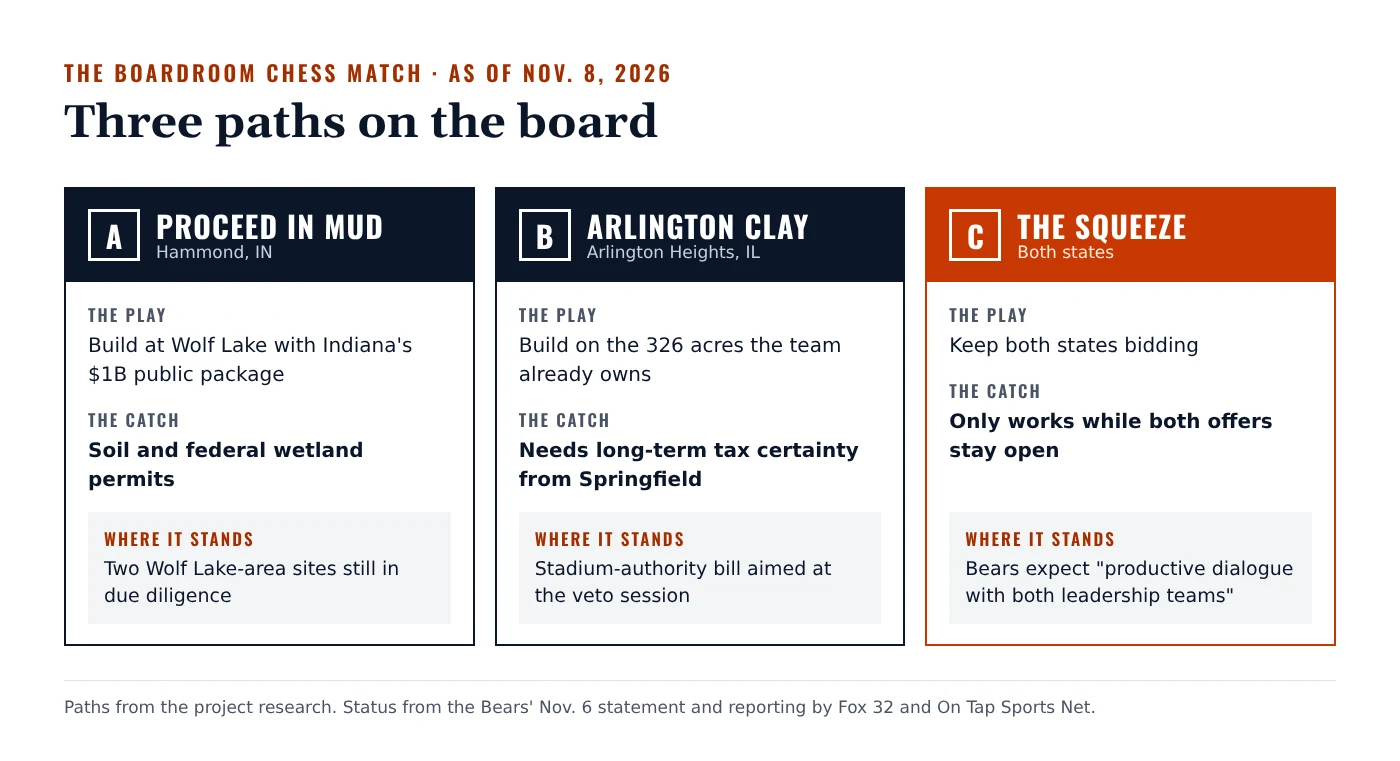
| PATH | THE PLAY | THE CATCH | WHERE IT STANDS |
|---|---|---|---|
| A · Proceed in mud | Build at Wolf Lake with Indiana’s $1B public package | Soil and federal wetland permits | Two Wolf Lake-area sites still in due diligence |
| B · Arlington clay | Build on the 326 acres the team already owns | Needs long-term tax certainty from Springfield | Stadium-authority bill aimed at the veto session |
| C · The squeeze | Keep both states bidding | Only works while both offers stay open | Bears expect “productive dialogue with both leadership teams” |
In the research’s scenario, Path C means pushing Indiana to carry foundation and cleanup overruns while pushing Illinois toward tax certainty. That’s a scenario, not a public Bears demand. What’s public is the team’s Nov. 6 statement: “We have a responsibility and obligation to explore every option available to the club.”
The trap now runs on a clock
The research’s double-rejection trap goes like this: push Illinois too hard, then lose the federal wetland permit at Wolf Lake, and end up with no buildable site in either state. The permit half still matters. Federal rules give regulators strong grounds to favor a dry site the team already owns, but that presumption can be rebutted, and no permit decision is public.
The nearer risk is time. Indiana Gov. Mike Braun’s office says the state “has assembled an excellent deal to build a world-class stadium in Hammond” and that “it is nearly time for the state to shift its energy and resources to the next opportunity.” If Springfield passes a bill by Dec. 3, Path B opens. If it doesn’t, the squeeze leans on an offer Indiana is tired of holding open.

My read: the chess match worked. The tax fight pushed Illinois from offering a tax break to offering public ownership, a bigger move than it was willing to make a year ago. But the squeeze only pays off if one state is still at the table when the clock runs out.
Leverage builds stadiums. Running out the clock doesn’t.
THE PODCAST
The Boardroom Chess Match
Steph (NWI-native planner) and Matt (Chicago urbanist) on the leverage play: who blinks first, Springfield or Indianapolis?
OVER TO YOU
Does Illinois pass a stadium-authority bill by Dec. 3, or did the Bears squeeze one state too hard?
THE RESEARCH DESK
Show me the receipts.
This post is the fan-facing cut of an independent urban-planning research project. Here’s the full presenter deck and research report for anyone who wants the methodology, sources and numbers behind it.
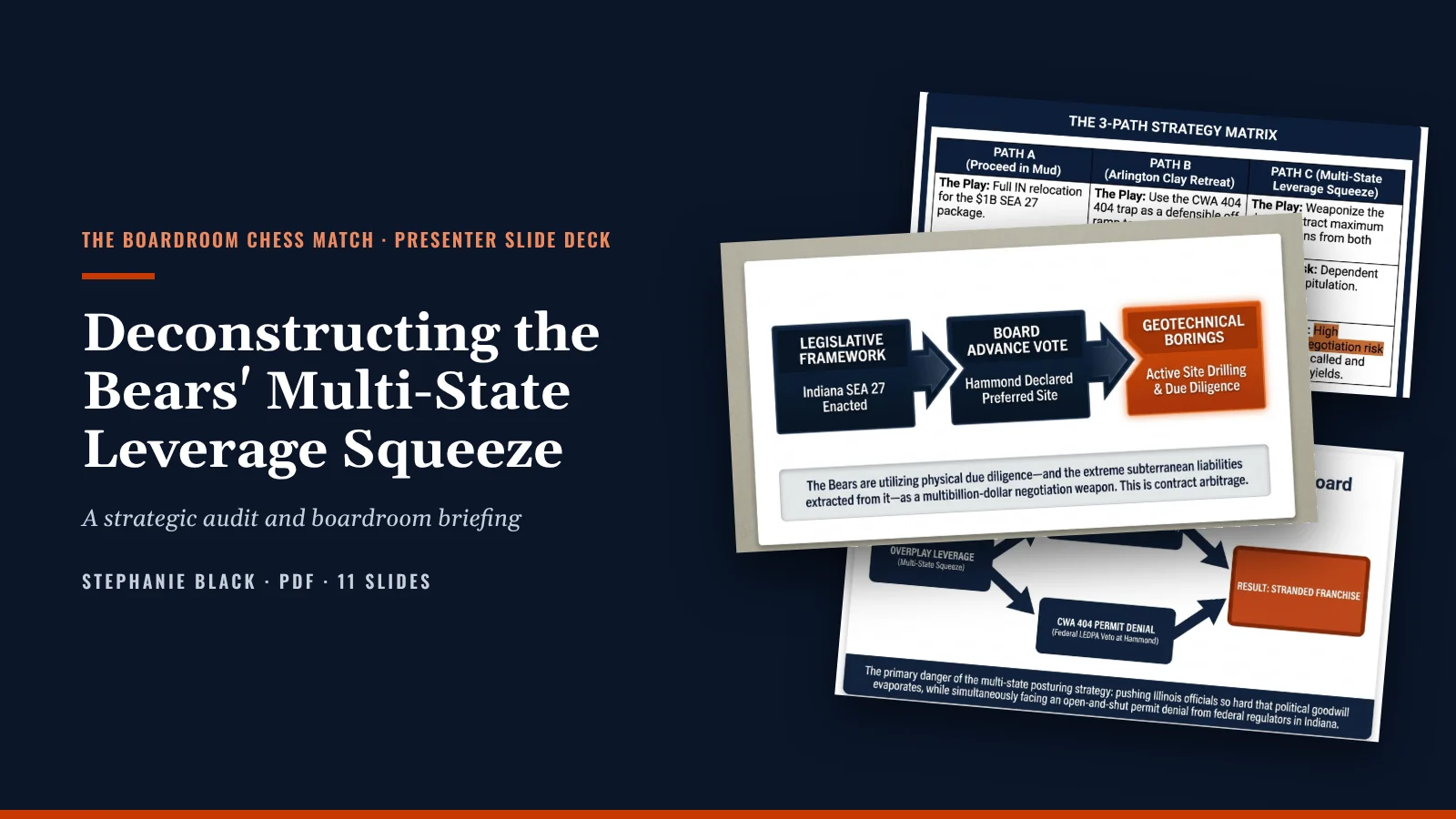
PRESENTER SLIDE DECK
Deconstructing the Bears' Multi-State Leverage Squeeze

RESEARCH REPORT
Deconstructing the Bears' Multi-State Leverage Squeeze: A Strategic Audit of Real Estate Arbitrage, Environmental Law, and Public Financing
WHAT'S IN THE RESEARCH
- Arlington Park tax standoff and the valuation gap
- SEA 27 and the public capital stack
- Three-path cost-risk matrix
- Double-rejection risk and the LEDPA rule
METHODS & SOURCES
- [Primary sources — Cook County assessment and appeal records, SEA 27 text, Illinois bill text, team statements]
- Compares the three site paths on construction cost, permits, public funding and timeline
- Read the full report →
CITE THIS RESEARCH
Black, S. (2026). Groundwork & Gridlock: The Boardroom Chess Match. CreativeTech Studio. [URL]

Stephanie Black
Urban planner and independent analyst from Crown Point, Indiana. Commutes into the Loop on I-90 and the South Shore Line, and audits stadium hype against the dirt, the statutes and the bond math.
