


Groundwork & Gridlock · The Geotechnical Gauntlet
The Geotechnical Gauntlet: The Dirt Doesn't Lie
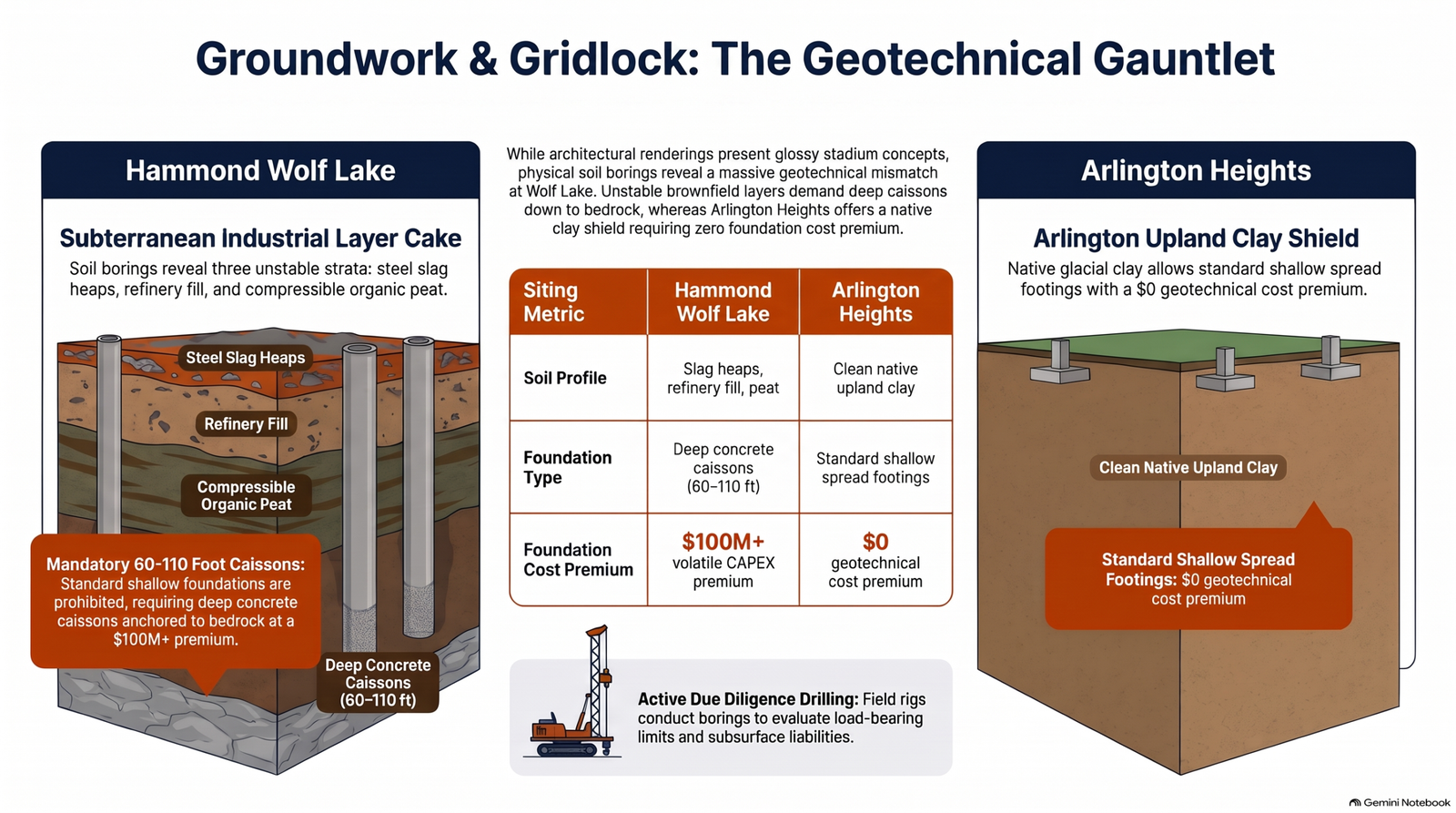
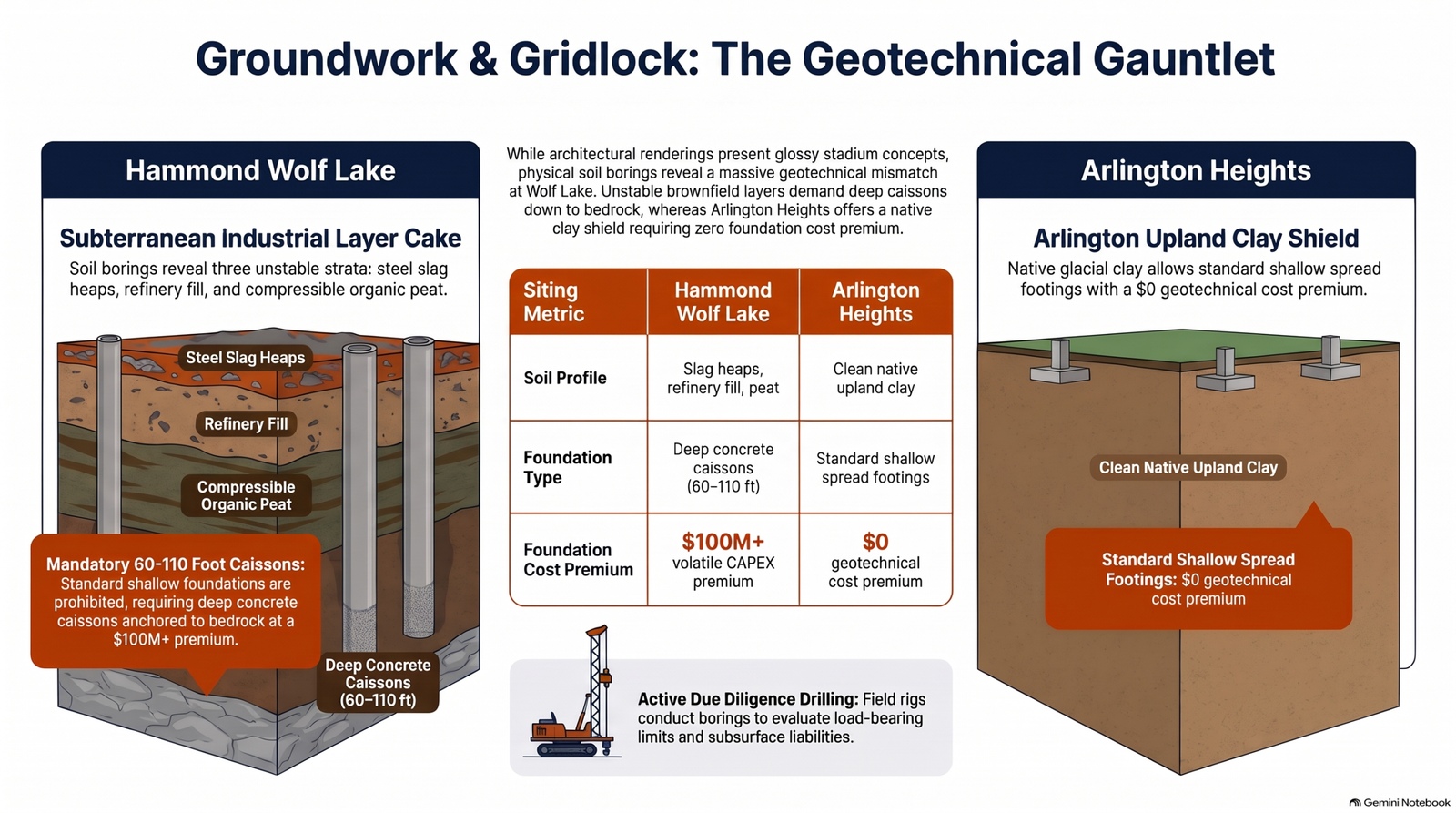
Above ground, Hammond's Wolf Lake sites look like a tailgater's dream. Below ground, the research found a three-layer problem that only deep foundations can solve.
Choose your format
READ
The article · 3 min
WATCH
Video edition · 22 min
SEE
Full-size infographic · free download
LISTEN
Podcast · 22 min
THE RESEARCH
Slide deck + full report · skip ahead
Every stadium pitch starts with a picture. A big roof, a sea of orange jerseys, a parking lot that seems to go on forever. The Bears’ Hammond pitch has all of that, and the above-ground case is real: more room, more parking and more space to tailgate than Soldier Field will ever have.
But you don’t build a stadium on a picture. You build it on dirt. According to my research, the ground around Wolf Lake is the toughest opponent this project faces: three layers of industrial leftovers sitting on top of the rock a stadium actually needs to stand on.
STATUS CHECK · AS OF NOV. 9, 2026
The Bears say they’re still “finalizing due diligence details across two sites in the Wolf Lake area” (team statement, Nov. 6). No soil-boring results from either site have been made public. Illinois lawmakers return Nov. 17–19 and Dec. 1–3 with a stadium bill on the table.
2 SITES
Wolf Lake-area sites still in due diligence
3 LAYERS
Slag, refinery fill and peat over bedrock, per the research
60–110 FT
Caisson depth to bedrock, per the research
$100M+
Foundation premium, the research’s estimate
Two sites, not one
“Wolf Lake” gets talked about like a single spot on the map. It isn’t. The Bears are working two pieces of land side by side in Hammond.
Lost Marsh covers more than 300 acres along Calumet Avenue and is home to the Lost Marsh Golf Course. That course was built on a reclaimed slag heap, a hill of leftover steel-mill waste. Hammond Mayor Thomas McDermott calls it “a safe slag heap” and points out that the cleanup won a United Nations award in 1993. On Aug. 13, Bears President Kevin Warren said the team had finished its due diligence there and that Lost Marsh “remains viable.”
Wolf Lake Terminals is about 83 acres just west of I-90: former federal land surrounded by protected wetlands, with businesses still operating on it. That’s where crews took soil samples in late June. Warren said it could be “even better” for building one connected district, and he has said the two sites may be merged.

One more wrinkle: Bleacher Nation reported that federal permit records reference a 50-year easement on two lake basins at Lost Marsh, which would shrink the land around a stadium there. That’s one report, and the team hasn’t addressed it.
The above-ground pitch
This is the part fans can feel. Soldier Field has “roughly 6,000 parking spaces available today,” according to a Bears fan survey that WVPE reported on in September. The same survey describes 15,000 spaces “intentionally designed to support tailgating” next to a new stadium. My research counted 12,000+ stalls. Any way you count it, that’s more than double.

Add direct I-90 access and room for real tailgate lawns, and you can see why Hammond looks great on a whiteboard.
One thing I’ve cut: earlier versions of this research promised a 25-minute train ride straight to the gates. No direct rail link to a stadium site has been announced, so I’m not counting it.
The layer cake
Here’s where the research gets uncomfortable. It describes the ground around Wolf Lake as an “industrial layer cake,” with no stable native soil above the rock:
- Layer 1: steel slag. Leftover waste from a century of steelmaking.
- Layer 2: petroleum refinery fill. Soaked with hydrocarbons.
- Layer 3: organic peat. Soft, wet and compressible. Put weight on it and it squeezes like a sponge.
Under all of that sits the bedrock a stadium has to reach. Those layers are the research’s read; the team hasn’t released what its own borings found.

The mayor sees it differently. “The Lost Marsh Golf Course, the Wolf Lake area is pristine,” McDermott said in June. “It’s clean as a whistle.”
My read: those two claims can both be true. Clean is a question about what’s in the ground, and that fight gets its own post, The Environmental Gauntlet. Strong is a question about what the ground can hold up. A golf course and an NFL stadium ask very different things of the same dirt.
Clean and strong are two different questions.
Poles in the ground
If the top layers can’t carry the load, you go through them. Per the research, a standard shallow foundation won’t do the job at Wolf Lake. Engineers would drive steel piles and pour concrete caissons 60 to 110 feet down to bedrock.
The research puts the extra cost of that foundation work at $100 million or more, before a single seat goes in. Those are the research’s estimates. No public site plan or engineering report confirms them yet.
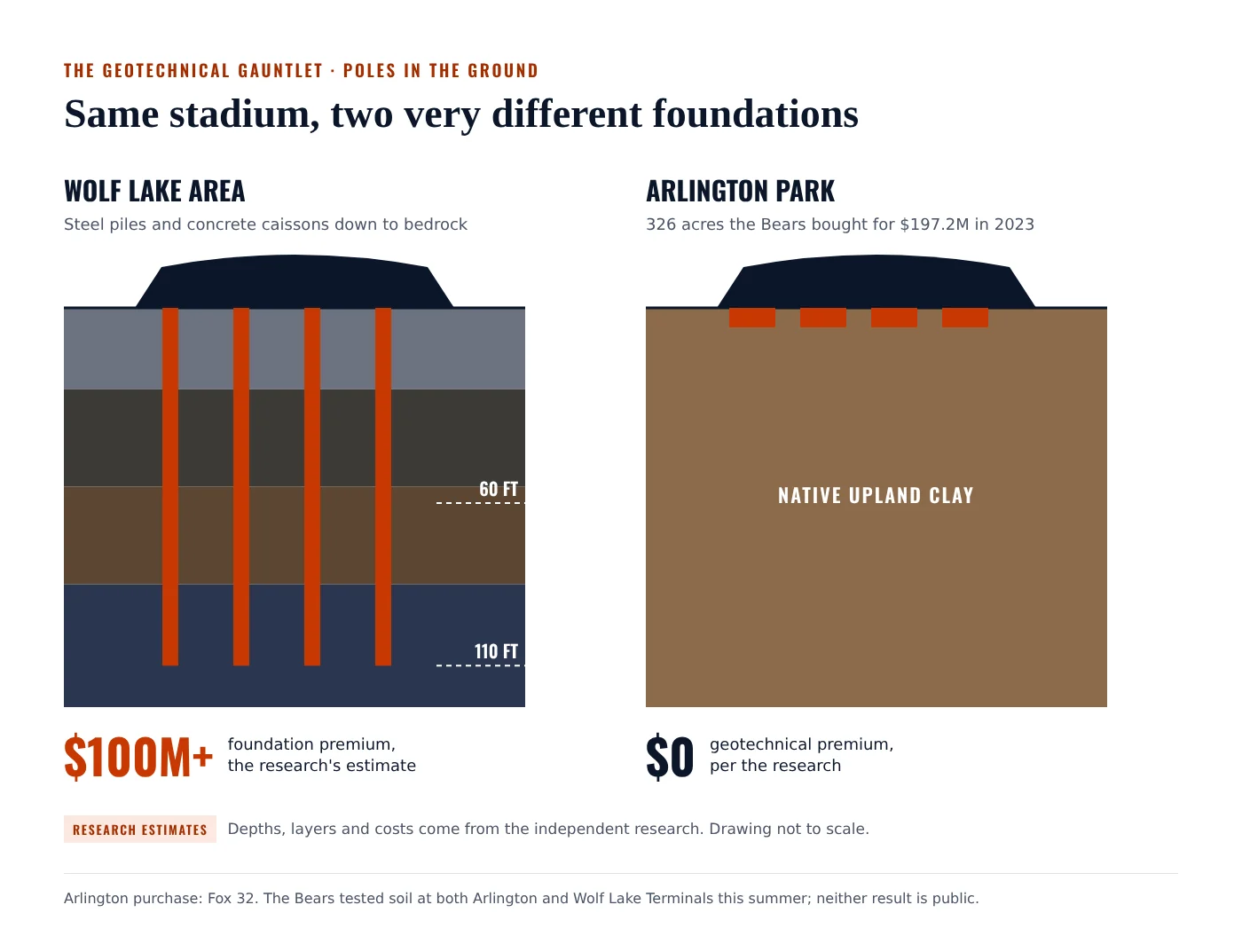
Compare that with Arlington Park. The Bears bought the 326-acre former racetrack for $197.2 million in 2023. The research describes native upland clay there that takes ordinary spread footings, with no geotechnical premium. The team tested soil at Arlington this summer too, and it hasn’t released those results either.
| LOST MARSH | WOLF LAKE TERMINALS | ARLINGTON PARK | |
|---|---|---|---|
| Size | 300+ acres | About 83 acres | 326 acres |
| What’s there now | Golf course on a reclaimed slag heap | Industrial terminal; businesses operating | Former racetrack, owned by the team |
| Public soil results | None released | None released (sampled late June) | None released |
| The research’s foundation read | Not broken out separately | Layer cake; caissons 60–110 ft* | Native clay; standard footings, $0 premium* |
*Per the research. Sources: Fox 32, Lakeshore Public Media, Sports Illustrated.
And the clock costs money too. In August, Warren said construction costs are rising by about $150 million a year.
The above-ground case for Hammond is strong. The below-ground case is still sealed inside soil samples nobody has published. Until those results come out, every rendering is a guess about what the dirt will allow.
Renderings sell the view. Borings set the price.
THE PODCAST
The Chicago Bears' Indiana Stadium Bluff
Podcast · about 22 min · MP3
The audio companion to this post. It was recorded before the latest updates, so the article has the current facts.
OVER TO YOU
If the Wolf Lake site costs $100M+ more just to stand up, are the parking and tailgate lawns worth it? Or does Arlington's clay win this round?
THE RESEARCH DESK
Show me the receipts.
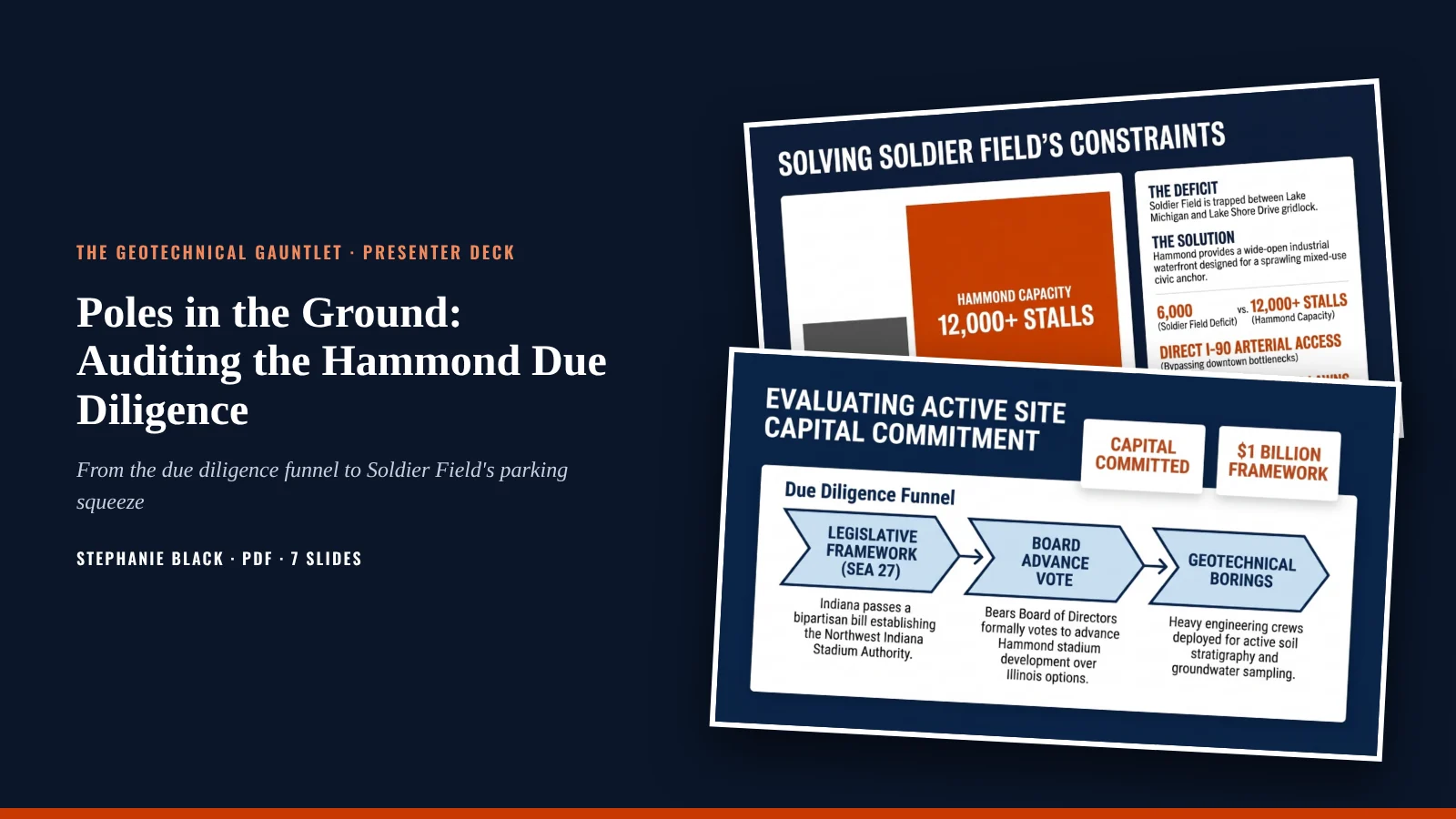
This post is the fan-facing cut of an independent urban-planning research project. Here’s the full presenter deck and research report for anyone who wants the methodology, sources and numbers behind it.
PRESENTER SLIDE DECK
Poles in the Ground: Auditing the Hammond Due Diligence

WHAT'S IN THE RESEARCH
- Site capital commitment and Indiana’s financing framework
- The Aug. 13 shift to Hammond
- Soldier Field’s parking and access limits
- A three-site siting matrix
- Commercial feasibility
- Subsurface conditions and three strategic paths
METHODS & SOURCES
- Public reporting, team statements and Indiana stadium legislation (HEA 1292, SEA 27)
- Compares Soldier Field, Arlington Heights and Hammond on acreage, parking, access, politics and soil
- Soil layers, caisson depths and costs are research estimates, not published boring results
- Read the full report →
CITE THIS RESEARCH
Black, S. (2026, November). Groundwork & Gridlock: Poles in the ground (Hammond due diligence) [Research report]. CreativeTech Studio. https://creativetech.studio/wp-content/uploads/2026/11/Groundwork-Gridlock-Research-Report-2.pdf

Stephanie Black
Urban planner and independent analyst from Crown Point, Indiana. Commutes into the Loop on I-90 and the South Shore Line, and audits stadium hype against the dirt, the statutes and the bond math.
