


Groundwork & Gridlock · The Environmental Gauntlet
The Environmental Gauntlet: What's Waiting Under Wolf Lake
Indiana can pass a stadium law in one session. The water table, the lead benchmarks and a federal wetland rule don't run on the legislative calendar.
Choose your format
READ
The article · [X] min
SEE
Full-size infographic · free download
LISTEN
Podcast with Steph & Matt · 5 min
WATCH
Video explainer · 5 min
THE RESEARCH
Slide deck + full report · skip ahead
Wolf Lake’s dirt has already been read. Now comes the harder question: what happens when you push a stadium’s worth of concrete through it?
Three sets of regulators wait at the bottom of those borings: Indiana’s Department of Environmental Management (IDEM), US EPA Region 5 and the Army Corps of Engineers. None of them votes in Indianapolis.
STATUS CHECK · AS OF NOV. 9, 2026
The Bears say they’re “finalizing due diligence details across two sites in the Wolf Lake area.” No federal wetland permit application for either site is public. Illinois’ veto session runs Nov. 17–19 and Dec. 1–3.
200 PPM
Soil lead screening level EPA set in 2024, the research’s planning benchmark
$25K/DAY
Most Indiana law allows per violation in civil penalties
326 ACRES
Dry upland Arlington Park site the Bears already own
2 SITES
Wolf Lake-area sites still in due diligence
The piston effect
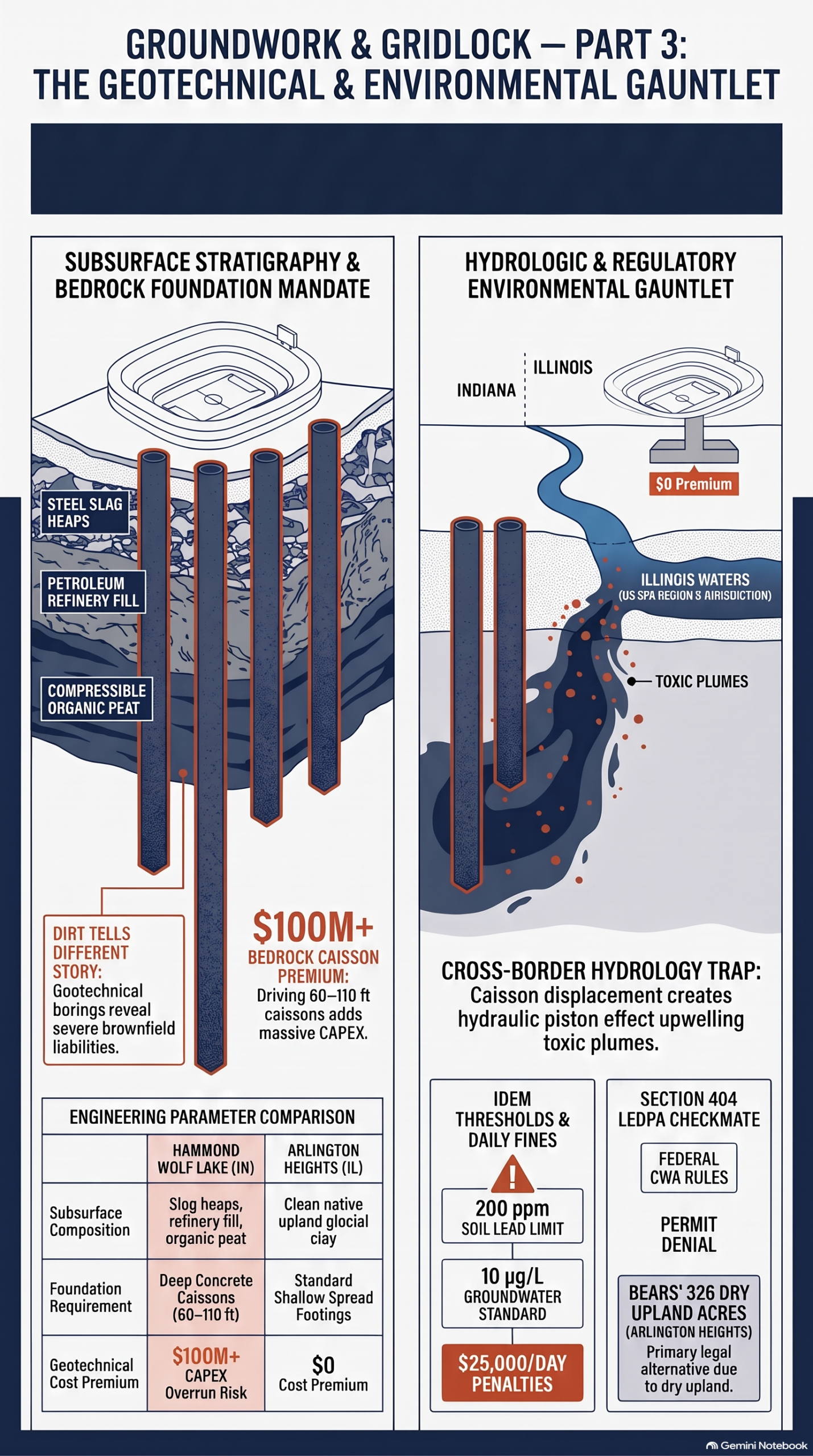
Start with the research’s worst case. To reach bedrock, the research says foundations would have to go 60 to 110 feet down through slag, refinery fill and peat. Drive that much concrete and steel into saturated ground and it can work like a piston, pushing dormant lead and petroleum plumes up into the shallow water table.
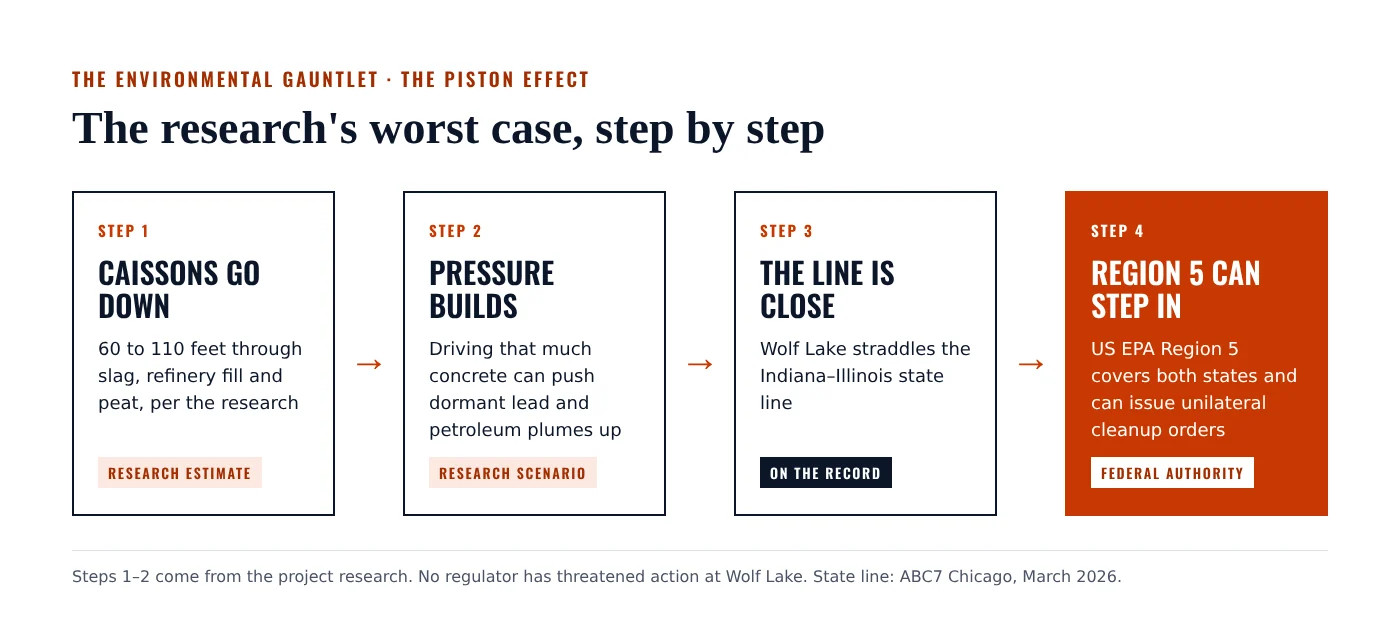
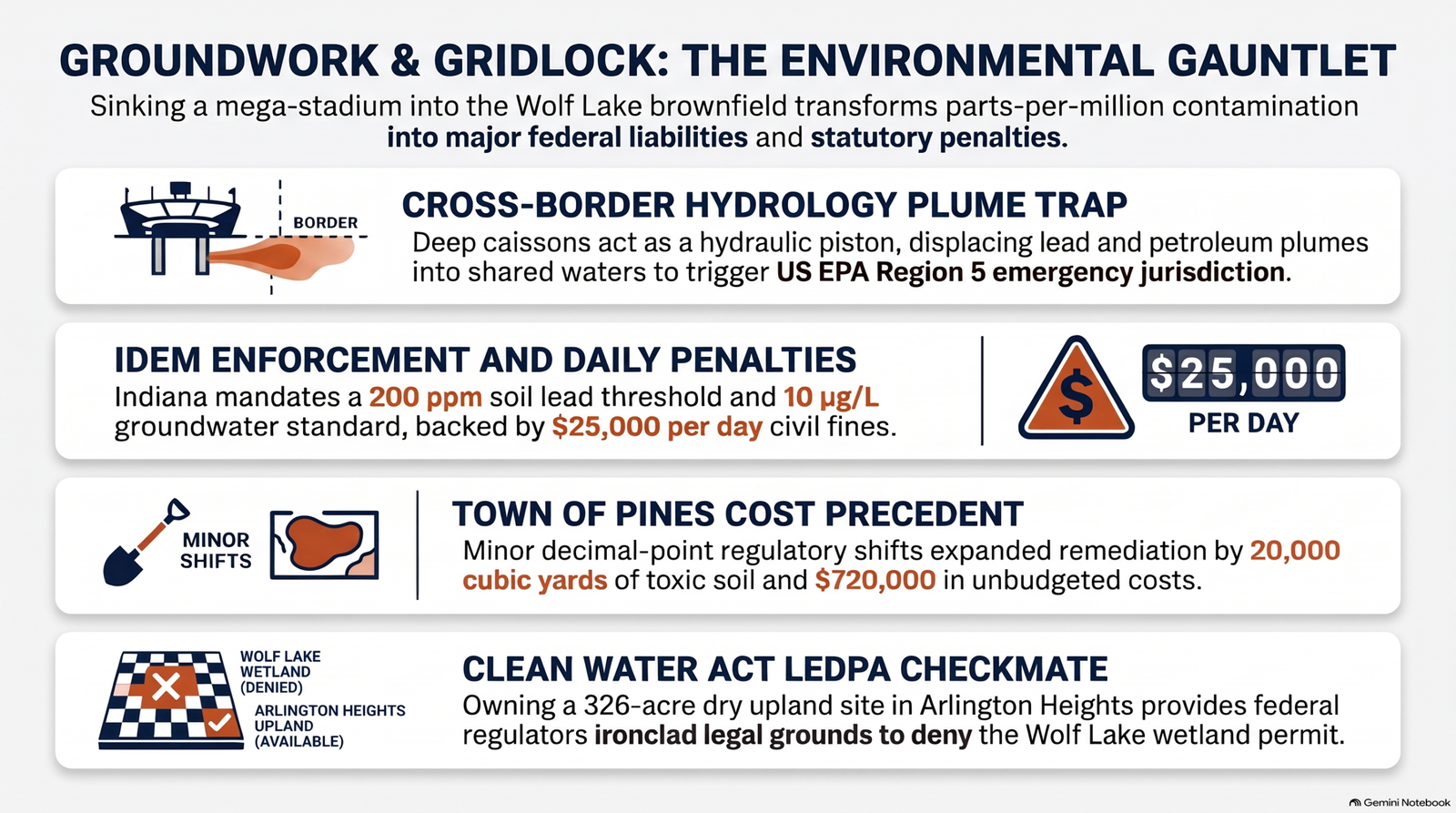
That’s where geography matters. Wolf Lake straddles the Indiana–Illinois line, so contamination that drifts across it stops being only Indiana’s problem. US EPA Region 5 covers both states and can issue unilateral orders that force a cleanup, and a cleanup fight can freeze a job site. To be clear, that’s a scenario in the research. No regulator has threatened it.
The decimal-point problem
Contamination limits are written in parts per million, but they’re paid for in truckloads. The research plans around two benchmarks: 200 ppm of lead in soil and 10 µg/L in groundwater. The 200 ppm figure is the residential screening level EPA set in January 2024, down from 400. EPA’s October 2025 directive then set a 600 ppm removal level and eased a stricter 100 ppm tier for sites with more than one lead source. Which numbers IDEM would apply at Wolf Lake isn’t public.
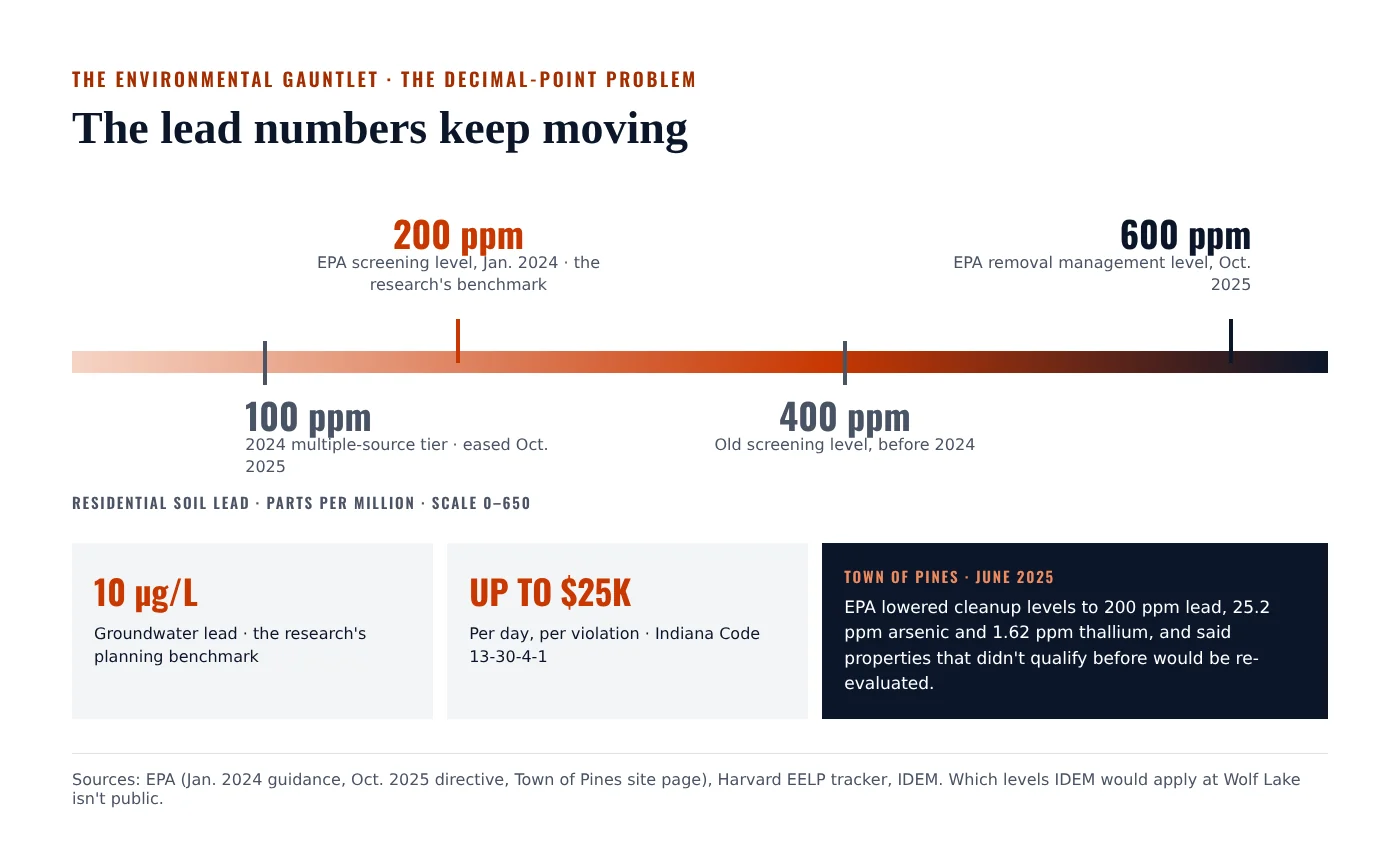
The penalty side is firmer. Indiana law allows civil penalties of up to $25,000 per day for each violation. The research treats that ceiling as a planning benchmark; actual fines are set case by case.
For a local reminder that the numbers move, look down the shoreline to the Town of Pines in Porter County. In June 2025, EPA lowered the cleanup levels at the coal-ash site there to 200 ppm for lead, 25.2 ppm for arsenic and 1.62 ppm for thallium, and said properties that didn’t qualify before would be re-evaluated. Change a decimal and you can redraw the cleanup map.
| THE BENCHMARK | THE NUMBER | WHERE IT COMES FROM | ON A STADIUM SITE |
|---|---|---|---|
| Soil lead screening | 200 ppm | EPA, Jan. 2024 (the research’s benchmark) | More soil to test, dig and haul |
| Soil lead removal | 600 ppm | EPA directive, Oct. 2025 | Triggers removal planning |
| Groundwater lead | 10 µg/L | The research’s benchmark | Dewatering and containment |
| Civil penalty | Up to $25,000 a day | Indiana Code 13-30-4-1 | Fines can stack during delays |
The LEDPA question
This is the federal one. Filling wetlands takes a Clean Water Act Section 404 permit from the Army Corps of Engineers. Its rules say no fill “shall be permitted if there is a practicable alternative” that does less harm to the aquatic ecosystem. That’s the LEDPA test: the Least Environmentally Damaging Practicable Alternative. For projects that don’t need to sit in a wetland, and a football stadium doesn’t, those alternatives “are presumed to be available, unless clearly demonstrated otherwise.”
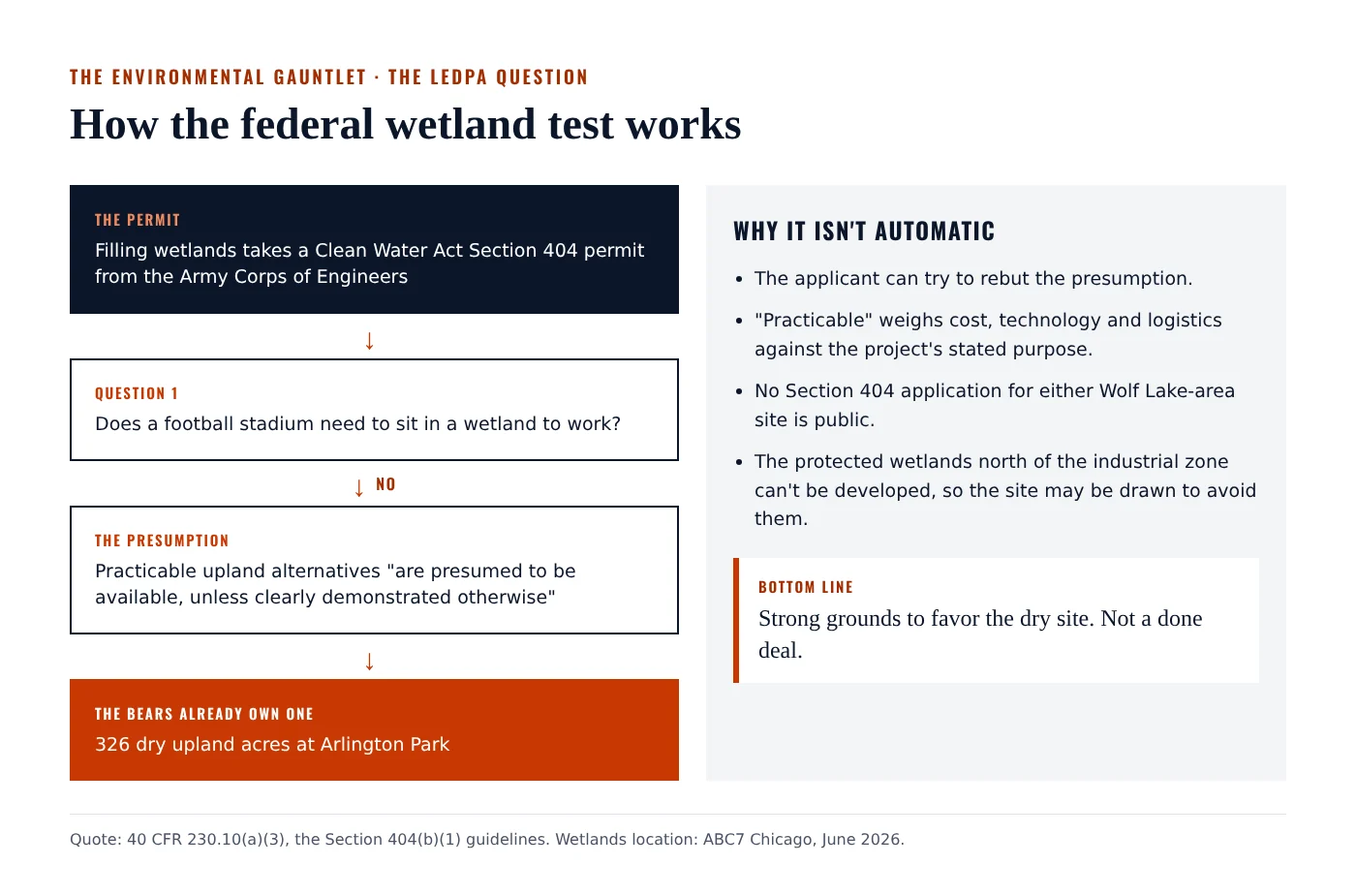
And the Bears already own one: 326 dry upland acres at Arlington Park. That gives regulators strong grounds to favor the dry site. It isn’t automatic. The team can try to rebut the presumption, “practicable” is judged against the project’s stated purpose, and it isn’t public whether either Wolf Lake-area site would need a wetland-fill permit at all. Reporting this summer noted that the protected wetlands north of the industrial zone can’t be developed.
Indiana can pass a law in one session. It can't pass a waiver from federal water law.
Where it stands
None of this has been tested in public yet. Soil testing at Wolf Lake Terminals started in late June, and sports consultant Marc Ganis called it routine: “They’re level one, level two, level three environmental, as they’re called.” On Nov. 6, the Bears said they’re “finalizing due diligence details across two sites in the Wolf Lake area” and expect “productive dialogue with both leadership teams in the coming weeks.”
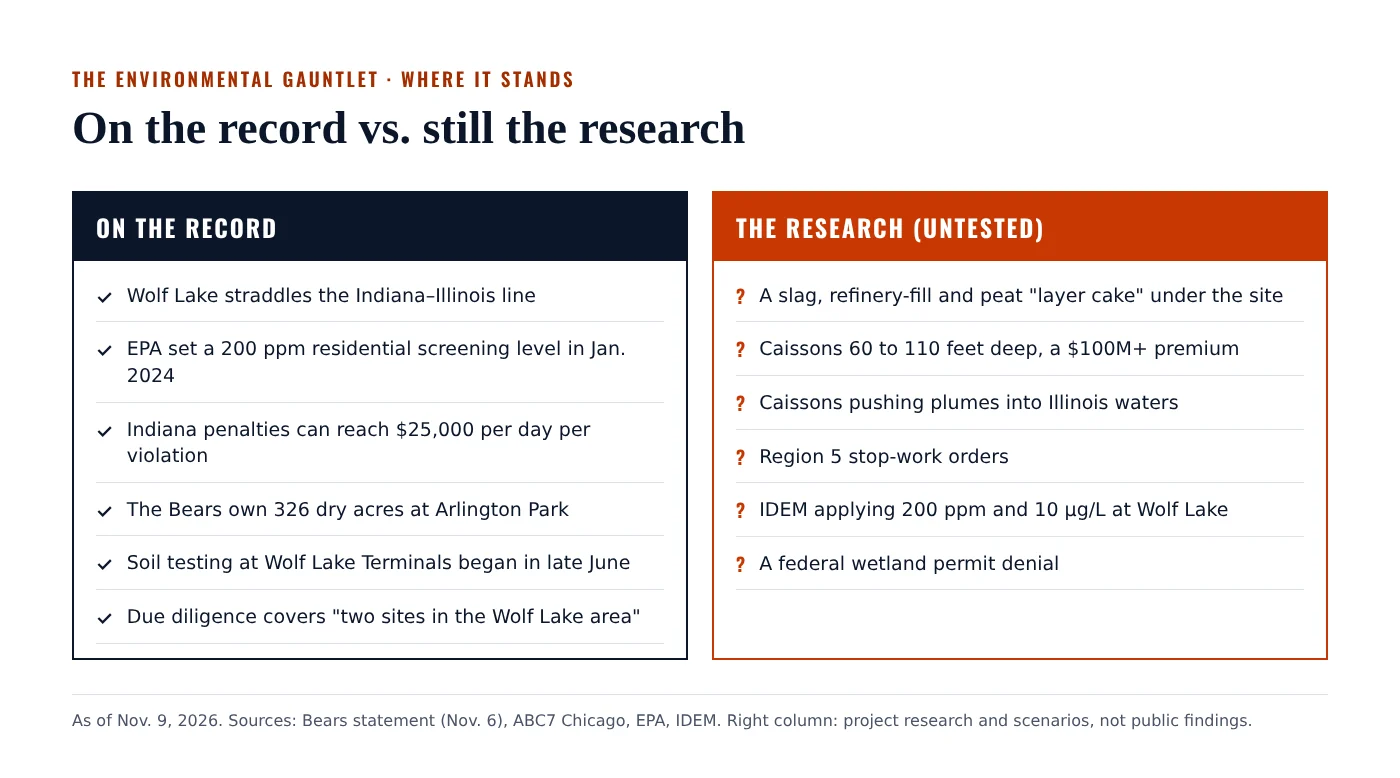
My read: the environmental gauntlet isn’t a wall. It’s a meter that runs on time and money. Every month of testing, permitting and cleanup planning in Hammond is another month for Springfield to make its own offer, and the veto session ends Dec. 3.
Legislatures move fast. The water table doesn’t read the calendar.
THE PODCAST
The Environmental Gauntlet, out loud
Steph and Matt talk through the piston effect, the lead numbers and the federal wetland rule. It was recorded from the original research, so check the article above for the updated numbers.
MP3 · 5:17 · Download MP3
THE VIDEO
Watch the explainer
The same conversation as a video, for anyone who’d rather hit play here or share it.
MP4 · 5:22 · Download MP4
OVER TO YOU
Is Wolf Lake's dirt a dealbreaker, or just a bill the right offer can cover?
THE RESEARCH DESK
Show me the receipts.
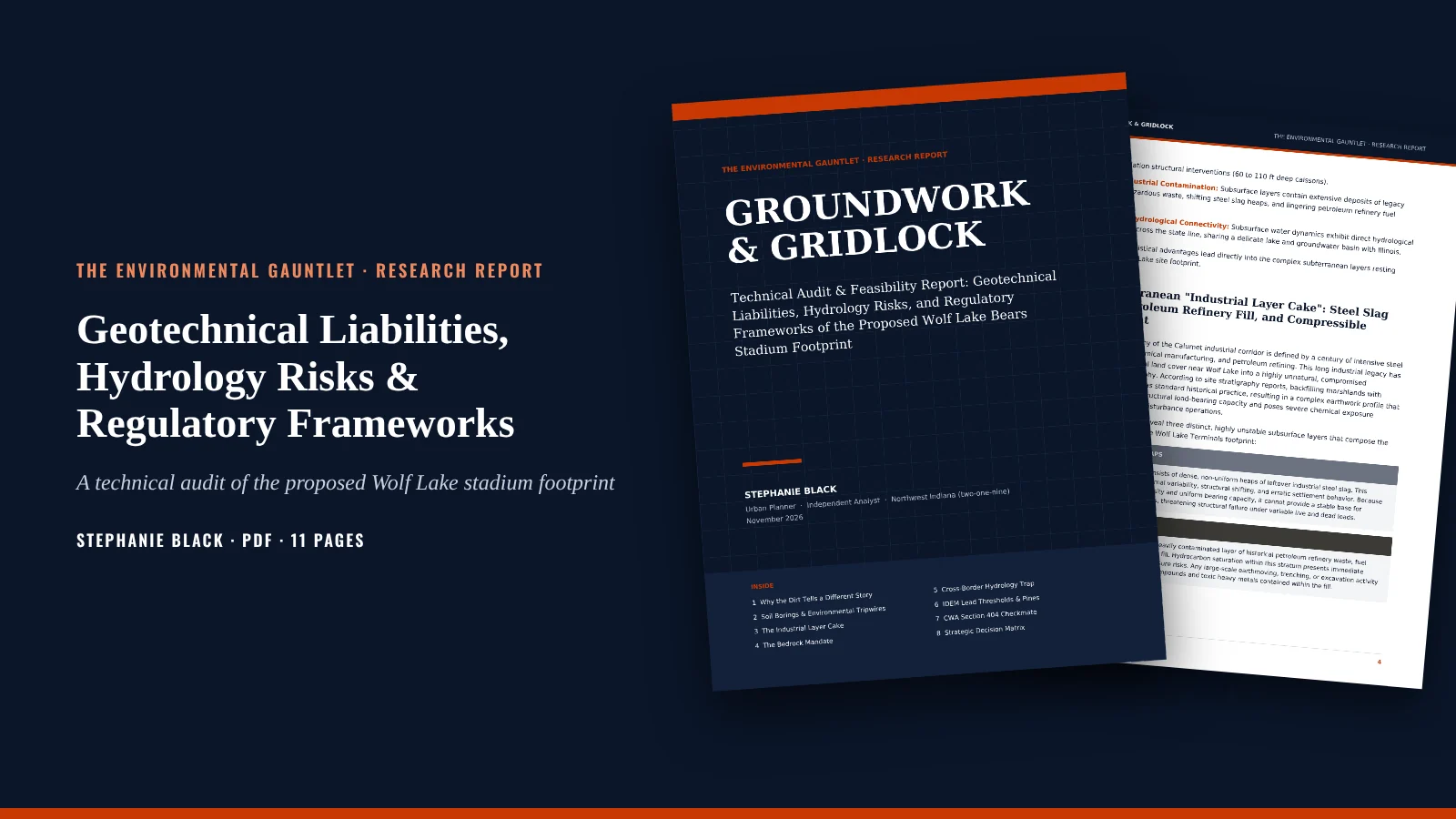
This post is the fan-facing cut of an independent urban-planning research project. Here’s the full presenter deck and research report for anyone who wants the methodology, sources and numbers behind it.

RESEARCH REPORT
Technical Audit & Feasibility Report: Geotechnical Liabilities, Hydrology Risks, and Regulatory Frameworks of the Proposed Wolf Lake Bears Stadium Footprint
WHAT'S IN THE RESEARCH
- Soil borings and the industrial layer cake
- Cross-border hydrology and US EPA Region 5
- Lead benchmarks and the Town of Pines
- Clean Water Act Section 404 and the LEDPA test
- Three-path cost-risk matrix
METHODS & SOURCES
- [Primary sources — soil-boring summaries, EPA and IDEM lead guidance, Indiana penalty law, Section 404(b)(1) guidelines]
- Compares Wolf Lake and Arlington Heights on foundations, contamination limits and federal permits
- Read the full report →
CITE THIS RESEARCH
Black, S. (2026). Groundwork & Gridlock: The Environmental Gauntlet. CreativeTech Studio. [URL]

Stephanie Black
Urban planner and independent analyst from Crown Point, Indiana. Commutes into the Loop on I-90 and the South Shore Line, and audits stadium hype against the dirt, the statutes and the bond math.
