

Part 2 of 4 · The Geotechnical Gauntlet
The Dirt Doesn't Lie: Why Wolf Lake Needs 110-Foot Caissons and Arlington Heights Doesn't
Renderings show the lakefront bowl. Soil borings show slag, refinery fill and a wet sponge of peat. One of those decides the budget.
Stephanie Black
Urban Planner & Independent Analyst · [PUBLISH DATE] · [X] min read
Three ways to run this play
The article · [X] min
Full-size infographic · free download
Podcast with Steph & Matt · [MM:SS]
Slide deck + full report · skip ahead
Part 1 was about speed: signed law, a $1 billion framework and a rail line that already runs. Speed gets you to the site. It doesn’t tell you what’s under it.
The Phase II soil borings at Wolf Lake do. And they say there is no stable native ground to build on.
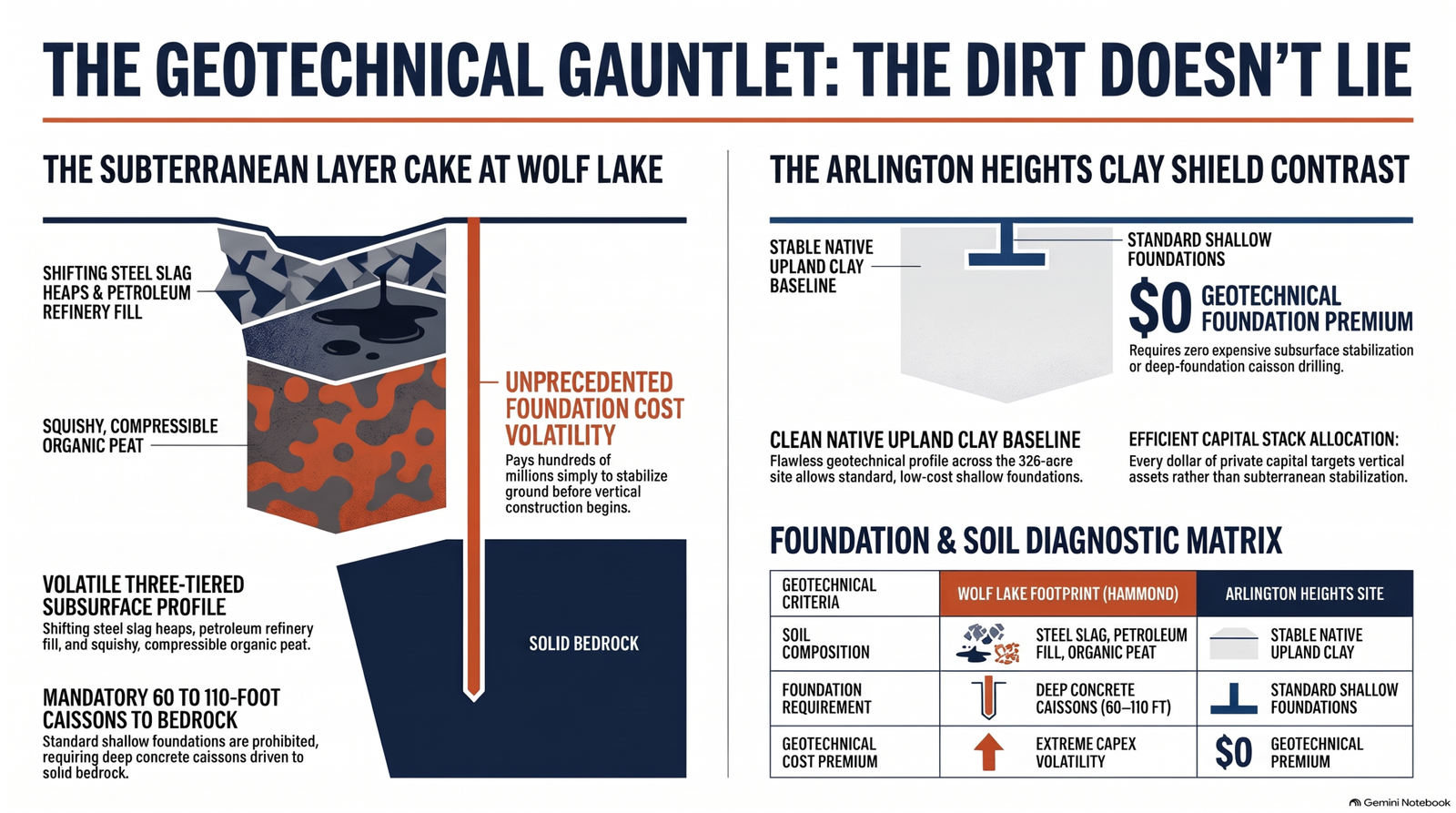
3 LAYERS
Slag, refinery fill, peat. Zero stable native soil
60–110 FT
Caisson depth needed to reach bedrock
$100M+
Volatile foundation CAPEX premium at Wolf Lake
$0
Geotechnical premium on Arlington’s upland clay
1. Renderings vs. borings
A rendering is a marketing document. A boring log is an engineering document. When the two disagree, the boring log wins every time, and it sends the bill to whoever signed the construction contract.
2. The industrial layer cake
A century of heavy industry along the lakefront left Wolf Lake sitting on three stacked problems instead of ground.
LAYER 1 · STEEL SLAG
Foundry waste heaps. Uneven, unengineered fill
LAYER 2 · PETROLEUM REFINERY FILL
Saturated with hydrocarbons, VOCs and PAHs
LAYER 3 · ORGANIC PEAT
Water-logged and compressible. Behaves like a wet sponge under load
BEDROCK · 60–110 FT DOWN
The first layer a stadium can actually stand on
You can't spread a 70,000-seat bowl across a wet sponge.
3. The bedrock mandate
On this profile, shallow spread footings are off the table, structurally and legally. Engineers have to drive steel piles and pour concrete caissons 60 to 110 feet down, through all three layers, to reach bedrock. That’s a $100M+ capital premium before a single seat goes in, and it’s volatile: every boring that comes back deeper than expected moves the number.
4. The Arlington shield
The Bears already own the alternative. They bought the 326-acre Arlington Park site in 2023 for $197.2 million, and it sits on clean native upland clay. Standard shallow foundations. No geotechnical premium.
| THE GROUND | HAMMOND / WOLF LAKE | ARLINGTON HEIGHTS |
|---|---|---|
| Soil | Slag, refinery fill, peat | Native upland clay |
| Foundation | Piles & caissons, 60–110 ft | Standard shallow footings |
| Geotech premium | $100M+ and volatile | $0 |
| Site control | Proposed lakefront district | 326 acres, owned since 2023 ($197.2M) |
Indiana won the race to the table. The dirt is where the bill shows up, and right now Arlington’s clay is the cheapest leverage the Bears own.
Renderings sell the dream. Borings set the budget.
The podcast · Part 2
Over to you
Is a $100M+ foundation premium a price worth paying for the 219 — or the off-ramp that sends the Bears back to Arlington's clay?
Up next · Part 3
The Research Desk · Part 2
Show me the receipts.
This post is the fan-facing cut of an independent urban-planning research project. Here’s the full presenter deck and research report for anyone who wants the methodology, sources and numbers behind it.

Presenter slide deck
The Geotechnical Gauntlet: The Dirt Doesn't Lie
groundwork-and-gridlock-part-2-slides · [N] slides

Research report
Sinking Millions in the Mud: The Volatile Geotechnical Strata [FULL TITLE]
PDF · [N] pages · [FILE SIZE]
What's in the research
- Phase II boring profile: the Wolf Lake “industrial layer cake”
- Bedrock mandate: pile & caisson depths (60–110 ft)
- Foundation CAPEX premium & volatility ($100M+)
- Wolf Lake vs. Arlington Heights soil comparison
Methods & sources
- [Primary sources — Phase II borings, geotechnical reports, Arlington Park acquisition records]
- [Analysis approach in one line]
- Full source list (in report appendix) →
Cite this research
Black, S. (2026). Groundwork & Gridlock, Part 2: The Geotechnical Gauntlet: The Dirt Doesn’t Lie. CreativeTech Studio. [URL]

Stephanie Black
Urban planner and independent analyst from Crown Point, Indiana. Commutes into the Loop on I-90 and the South Shore Line, and audits stadium hype against the dirt, the statutes and the bond math.
