

Part 3 of 4 · The Environmental Gauntlet
Why a Federal Wetland Rule Could Hand Illinois the Win in the Bears' Stadium War
Driving 110-foot caissons through contaminated fill isn't just an engineering problem. It's a regulatory tripwire, and the Bears already own the land that springs it.
Stephanie Black
Urban Planner & Independent Analyst · [PUBLISH DATE] · [X] min read
Three ways to run this play
The article · [X] min
Full-size infographic · free download
Podcast with Steph & Matt · [MM:SS]
Slide deck + full report · skip ahead
Part 2 showed what’s under Wolf Lake. Part 3 is what happens when you drive a stadium’s worth of concrete through it.
Three regulators are waiting at the bottom of those borings: Indiana’s environmental agency, US EPA Region 5 and the Army Corps of Engineers.
200 PPM
IDEM soil lead limit (100 ppm near industrial sources)
10 µg/L
Indiana groundwater lead standard
$25K/DAY
Civil penalties for non-compliance
326 ACRES
Dry upland site the Bears already own
1. The piston effect
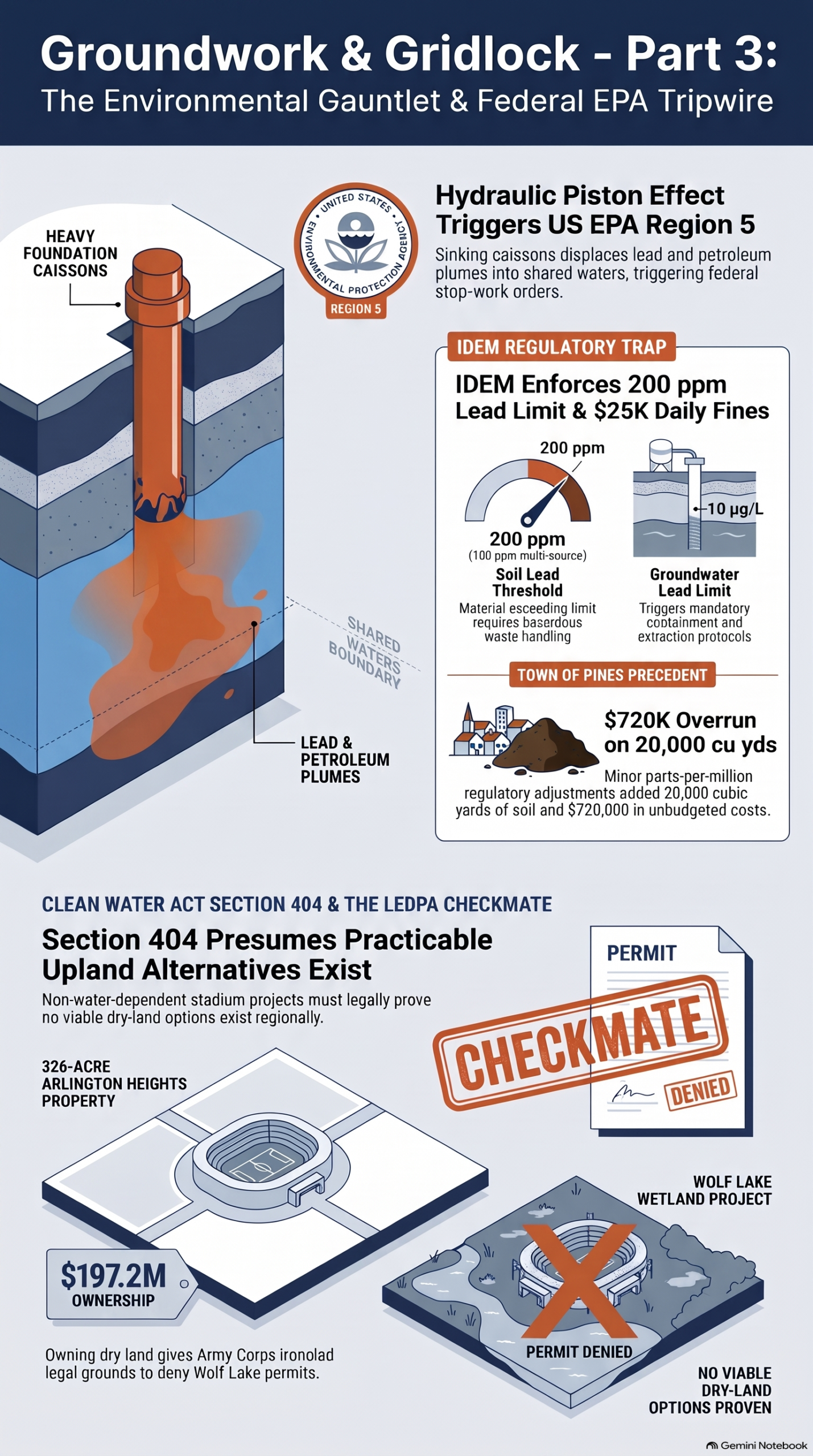
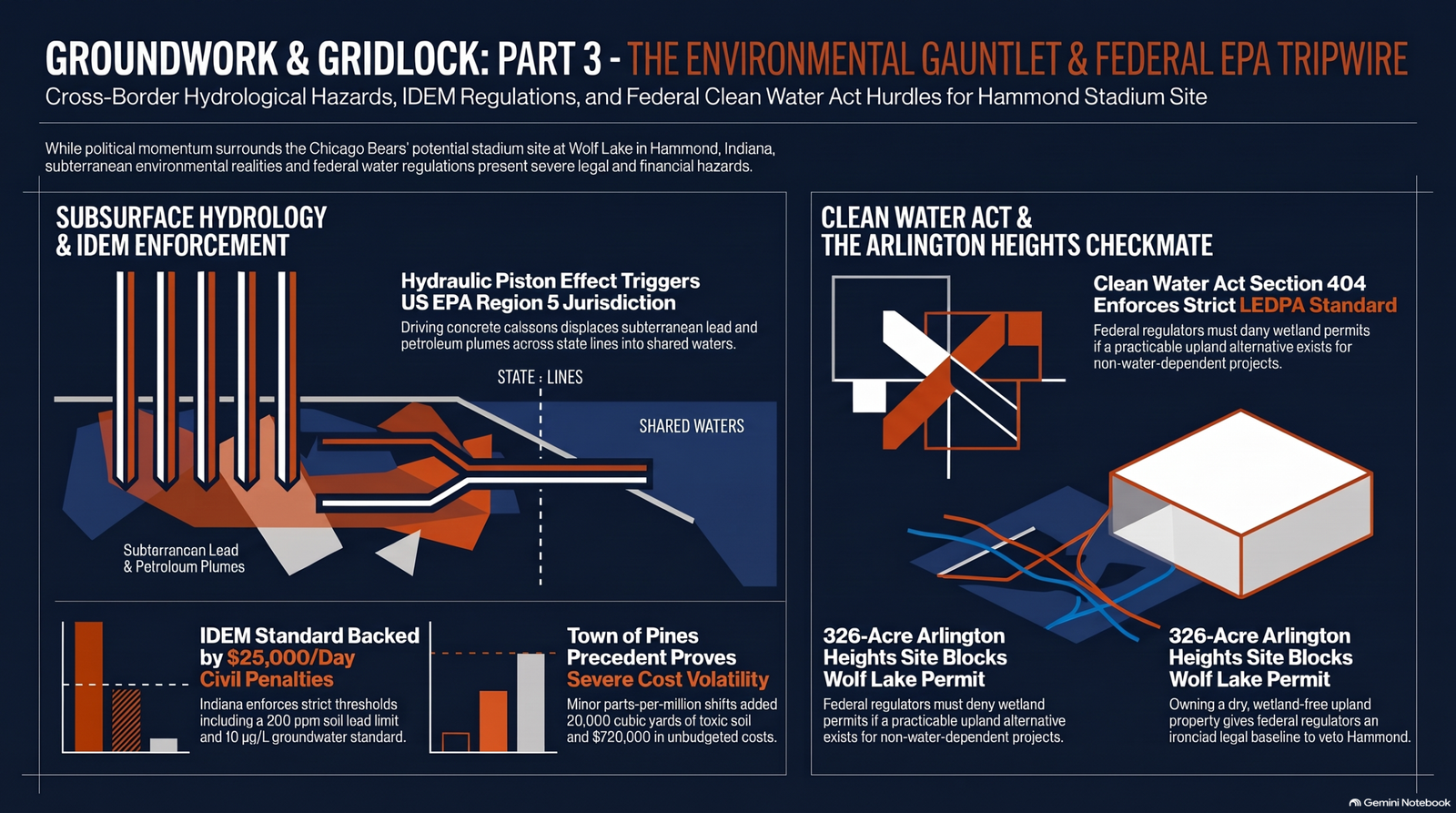
Driving caissons 110 feet down through saturated fill works like a piston. It can push dormant petroleum and lead plumes up into the shared water table. Wolf Lake sits on the state line, so if those plumes drift into Illinois it stops being only Indiana’s call: US EPA Region 5 can step in with unilateral orders and stop-work injunctions.
CAISSONS DRIVEN
110 ft through contaminated fill
PLUMES PUSHED UP
Lead & petroleum into groundwater
CROSS THE STATE LINE
EPA Region 5 can halt work
2. The decimal-point problem
IDEM’s soil lead limit is 200 ppm, cut to 100 ppm where secondary industrial sources are present, with a 10 µg/L groundwater standard and fines up to $25,000 a day. Small numbers, big bills: at the nearby Town of Pines cleanup, minor threshold adjustments added 20,000 cubic yards of soil and $720,000 in unbudgeted costs across just four properties. Now scale that to a stadium footprint.
| THE RULE | THE LIMIT | ON A STADIUM SITE |
|---|---|---|
| Soil lead (IDEM) | 200 ppm | Baseline cleanup trigger |
| Soil lead near industry | 100 ppm | More soil to dig and haul |
| Groundwater lead | 10 µg/L | Dewatering & containment |
| Non-compliance | Up to $25,000/day | Fines stack during delays |
Small numbers in parts per million become big numbers in dollars.
3. The LEDPA checkmate
To fill wetlands, the Bears need a Clean Water Act Section 404 permit from the Army Corps of Engineers. Under the LEDPA rule (Least Environmentally Damaging Practicable Alternative), regulators presume an upland alternative exists for projects that don’t need to sit on the water. A stadium doesn’t. And the Bears already own one: 326 dry upland acres in Arlington Heights. That gives regulators strong legal grounds to deny the Wolf Lake permit outright.
Indiana can pass a law in one session. It can’t pass a waiver from federal water law.
Legislatures move fast. Federal permits don’t.
The podcast · Part 3
Over to you
If federal water law blocks Wolf Lake, is Hammond still a real option, or was it always leverage?
Up next · Part 4
The Research Desk · Part 3
Show me the receipts.
This post is the fan-facing cut of an independent urban-planning research project. Here’s the full presenter deck and research report for anyone who wants the methodology, sources and numbers behind it.

Presenter slide deck
The Environmental Gauntlet & Federal EPA Tripwire
groundwork-and-gridlock-part-3-slides · [N] slides

Research report
Technical Audit: Geotechnical and Regulatory Risks of the Wolf Lake Stadium Proposal
PDF · [N] pages · [FILE SIZE]
What's in the research
- Cross-border hydrology & US EPA Region 5 jurisdiction
- IDEM lead thresholds & penalty exposure
- Town of Pines cleanup precedent
- Clean Water Act Section 404 / LEDPA analysis
Methods & sources
- [Primary sources — IDEM rules, EPA Region 5, USACE Section 404 guidance, Town of Pines records]
- [Analysis approach in one line]
- Full source list (in report appendix) →
Cite this research
Black, S. (2026). Groundwork & Gridlock, Part 3: The Environmental Gauntlet & Federal EPA Tripwire. CreativeTech Studio. [URL]

Stephanie Black
Urban planner and independent analyst from Crown Point, Indiana. Commutes into the Loop on I-90 and the South Shore Line, and audits stadium hype against the dirt, the statutes and the bond math.
