
In Part 1, we looked at the data: most small businesses are just getting started with AI, and it’s never been cheaper to begin. Now let’s look at what happens once you do.
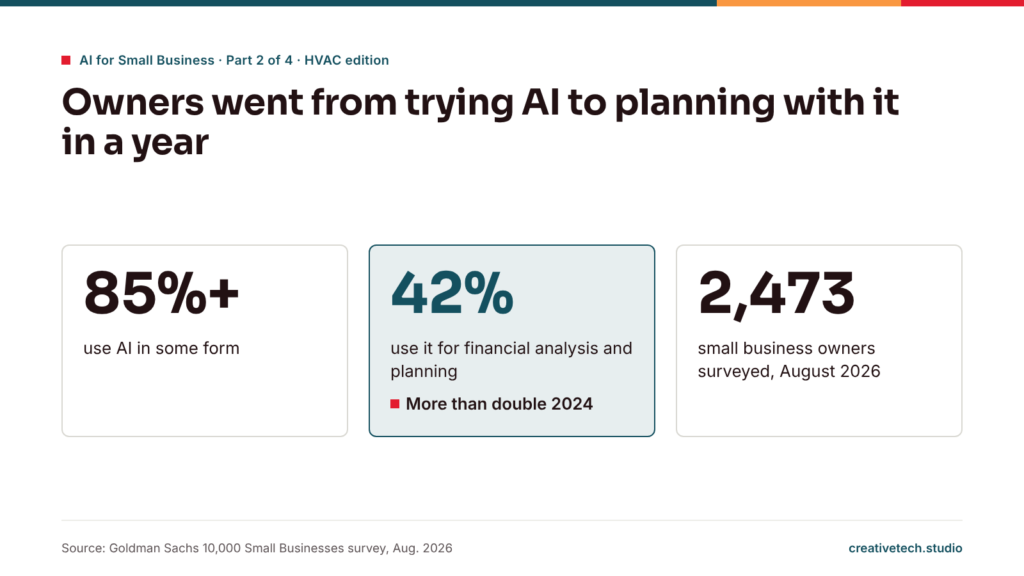
Goldman Sachs recently surveyed nearly 2,500 small business owners who completed its 10,000 Small Businesses program. More than 85% use AI in some form, and 42% now use it for financial analysis and planning, more than double the share in 2024.
of surveyed owners use AI in some form
now use AI for financial analysis and planning
that share more than doubled since 2024
Goldman Sachs 10,000 Small Businesses survey of 2,473 program alumni, conducted by Babson College, Aug. 10–24, 2026.
That jump happened in a single year. Plenty of these owners didn’t start out ahead. They picked AI up recently, one task at a time.
Below are three of their stories. After each one, I’ll show what the same idea could look like at our running example, Rearick’s Heating & Cooling, a Merrillville HVAC company that’s been serving Northwest Indiana since 1937.
As throughout the series, the Rearick’s scenarios are illustrations, not a description of how the company runs today.
The pickle maker who turned a 45-minute task into 2 minutes
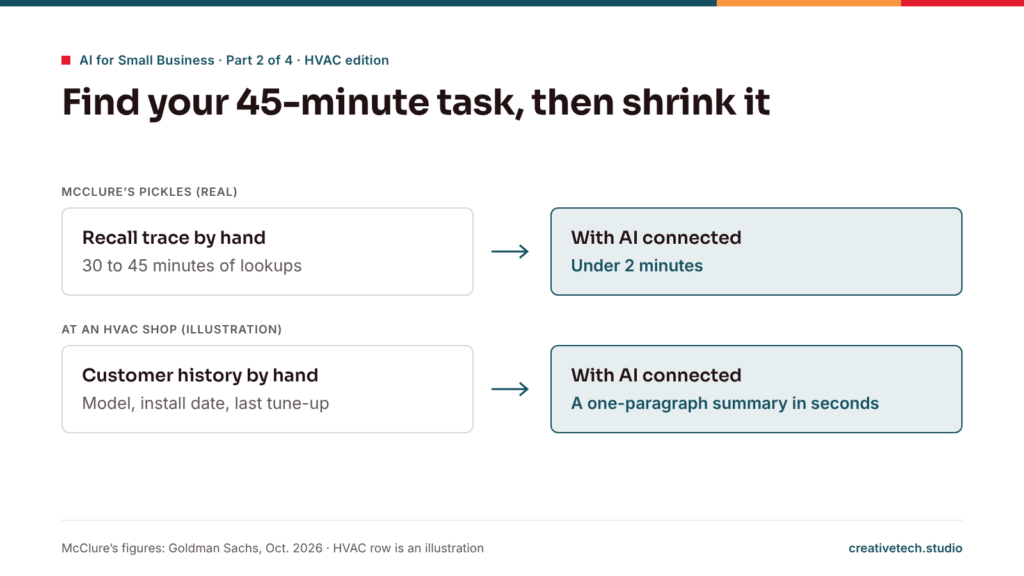
McClure’s Pickles in Detroit makes more than 3 million jars a year, and food safety comes first. The company regularly practices tracing ingredients in case of a recall. That used to mean 30 to 45 minutes of manual lookups.
Co-owner Bob McClure connected AI tools to the company’s business software. Now a trace takes under two minutes. He’s since built AI helpers that watch the equipment, draft supplier bills and double-check jar labels.
Here’s the best part: McClure is a former actor with no coding training. He tells the AI what he needs in plain English. It sometimes takes a few tries to get the instructions right, but he does it himself, without hiring a programmer.
The Rearick’s version
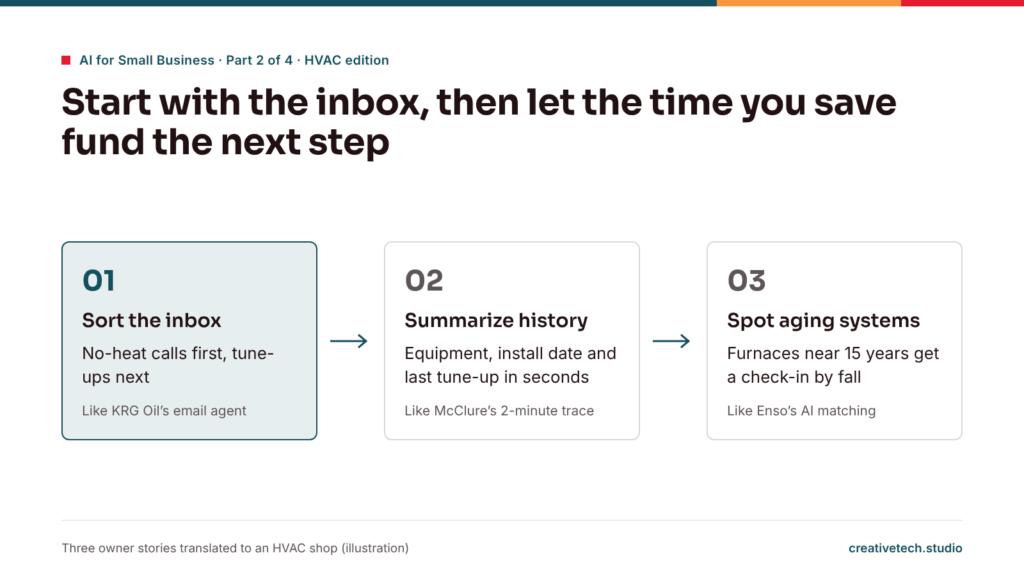
Every HVAC office has its own 45-minute task. Before calling a customer back, someone may need to dig up the equipment model, install date, last tune-up and any open warranty. If that history lives in the company’s service software, an AI tool connected to it could pull a one-paragraph summary in seconds. The technician walks in prepared, and the customer doesn’t have to repeat their story.
The engineer who let AI spot what her team couldn’t
Naomi Stone runs an environmental engineering firm in California. She launched a new venture, Enso, that uses AI to match companies sitting on leftover materials with buyers who can use them.
Matching that many buyers and sellers by hand would take her team ages. AI does it at a speed and scale they couldn’t manage alone, and it surfaces matches they hadn’t even considered. For her clients, a disposal cost becomes a new source of revenue.
The Rearick’s version
Rearick’s own site notes that a furnace typically lasts around 15 years. AI could scan years of service records to spot customers whose equipment is getting close to that age, or who have had repeat repairs. The team could reach out with a friendly check-in before a midwinter breakdown, not after. That’s better for the customer, and it turns a pile of old records into planned replacement work instead of emergency calls.