
AI for Small Business Series · Part 1 of 4
If it feels like every business but yours has AI figured out, take a breath. You’re not late. You’re right on time.
Throughout this series, I’m using one real local business as a running example: Rearick’s Heating & Cooling in Merrillville, Indiana. Rearick’s has been keeping Northwest Indiana homes comfortable since 1937. It serves 21 communities, from Boone Grove to Winfield, and handles everything from furnace repair to AC installs to duct cleaning. In other words, it’s exactly the kind of hands-on, phones-ringing, trucks-rolling small business the AI headlines tend to skip.
(A quick note: the AI scenarios in this series are illustrations of what’s possible for a business like Rearick’s, not a description of how Rearick’s runs today.)
What the data actually says
Scroll through social media for five minutes and you’d think every small business owner is running an army of AI assistants. The real numbers tell a calmer, more hopeful story.
The JPMorganChase Institute recently studied what small businesses actually spend on AI, not what they say in surveys. Researchers tracked payments to AI tools from 4.6 million small businesses with Chase business accounts between 2019 and 2025.
Most small businesses haven’t started yet
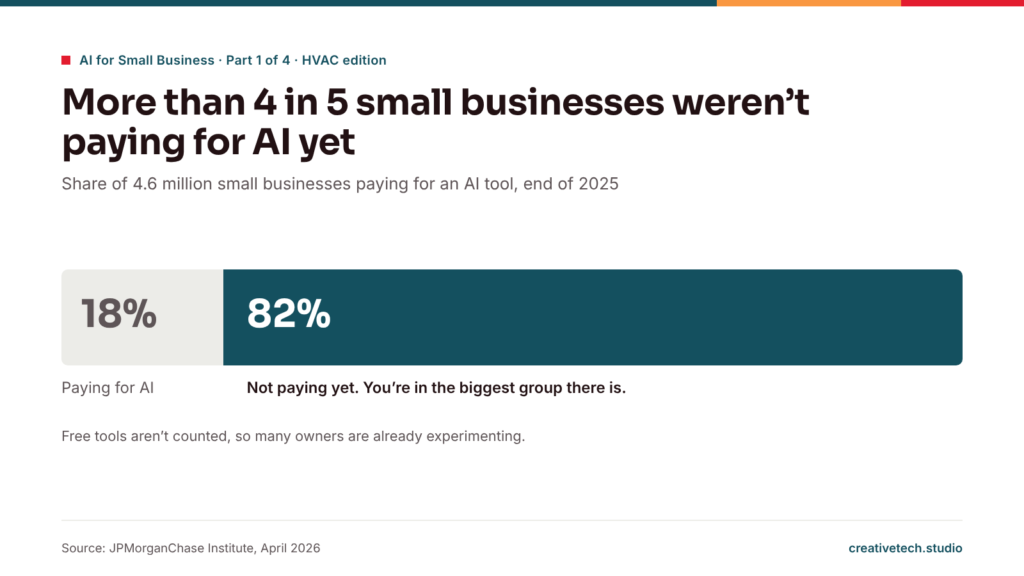
By the end of 2025, about 18% of the small businesses in the study were paying for an AI tool. Flip that around: more than 4 out of 5 hadn’t paid for one yet.
That count doesn’t include free tools, so plenty of owners are dabbling. But when it comes to building AI into how the business actually runs, most small businesses are still at the starting line.
Picture the front office at a company like Rearick’s on the first cold morning in October. The phones light up with no-heat calls, tune-up requests and “do you service Cedar Lake?” questions. Nobody in that office is behind on AI. They’re busy keeping customers warm, which is exactly why a little help would go a long way.
You’re not behind. You’re in the biggest group there is: owners who haven’t made their move yet.
Getting started has never been cheaper
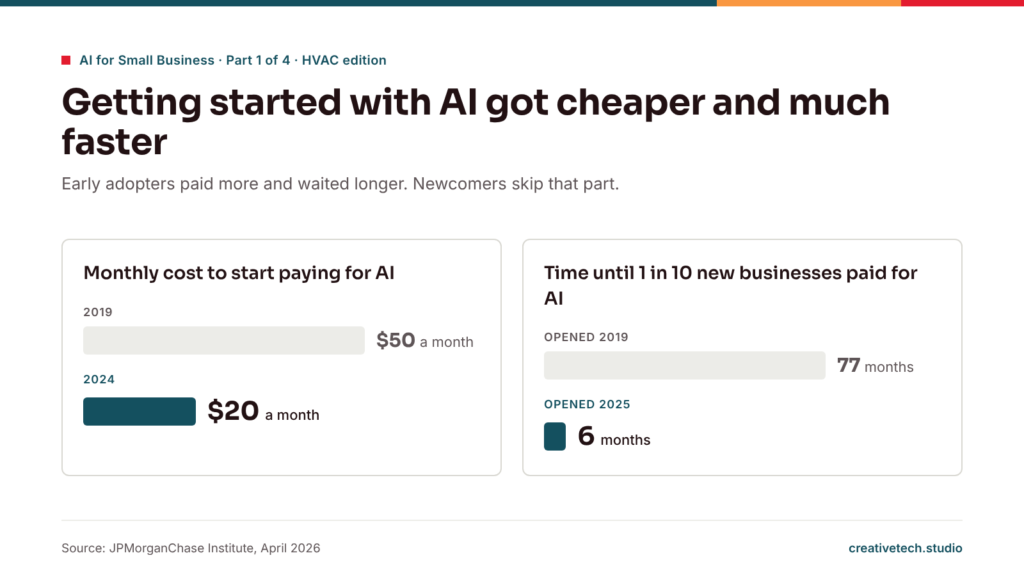
In 2019, the typical business spent about $50 a month just to get in the door with AI. By 2024, newcomers were starting at around $20 a month, thanks to the flood of affordable AI assistants.
For an HVAC shop, that’s less than lunch for the crew. Today, that buys an assistant that can draft a maintenance reminder, tidy up a technician’s notes into a clear customer summary, or answer common questions while the office is closed.
Newcomers catch up fast
Here’s the most encouraging number in the whole report. Among businesses that opened in 2019, it took more than six years for 1 in 10 to start paying for AI. Businesses that opened in 2025 hit that same mark in about six months.
AI got easier. And the tools don’t care whether your business is six months old or, like Rearick’s, nearly 90 years old. You don’t need a tech team, a big budget or years of planning. Owners are going from zero to useful in a matter of weeks.
Where the time savings show up
The data also shows what happens after owners get started, and it’s all about getting more done with the time you have:
- They stick with it. After a burst of experimenting in 2023, steady monthly users clearly outnumbered occasional ones again by 2025. Once owners find a tool that saves time, they keep it.
- They add a second tool. In 2025, about 28% of businesses using AI paid for two or more tools, up from 11% in 2019. A win in one area leads to the next.
- They start with everyday helpers. AI assistants that write, summarize and answer questions are now the biggest AI expense in every industry tracked. For a shop like Rearick’s, the first win is usually simple: less time on emails, callbacks and paperwork between service calls.
Trades have the most room to win
Adoption is highest in fields like information, professional services and education. It’s lowest in construction (about 9%) and transportation (about 5%).
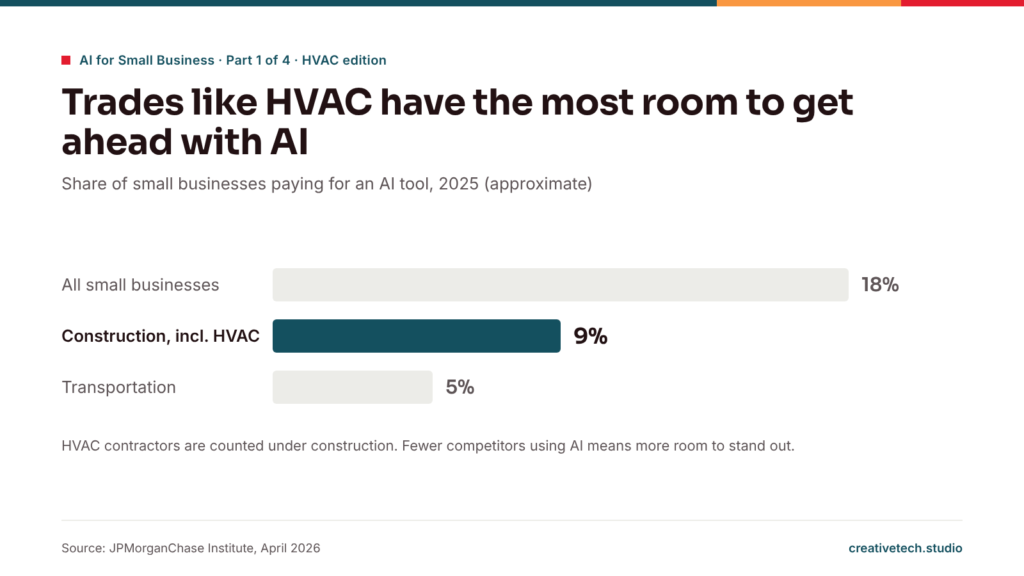
If you run a trade like HVAC, plumbing or electrical, that’s not bad news. It’s an opening. When few businesses in your field are using AI to send quotes faster, follow up on estimates or tame the paperwork, a few smart uses can set you apart. Rearick’s already competes on trust, training and a first-year satisfaction guarantee. Faster follow-up just makes that promise easier to keep.
Short on time? You’re not alone
One of the clearest findings: businesses with employees adopted AI at nearly twice the rate of solo owners, even when they earned less. The researchers point to bandwidth, not budget, as the likely barrier.
That fits the trades perfectly. Rearick’s office is open weekdays from 8 to 4, and during peak heating and cooling season, every hour is spoken for. The hurdle isn’t money. It’s finding an hour to try something new. The good news is that an hour is about all it takes to get started.
Your first three steps this week
- Name your biggest time drain. For an HVAC shop, it might be returning voicemails, writing up estimates or reminding customers about tune-ups. Pick the one you dread most.
- Try one AI assistant for $20 or less. Many have free plans. Ask it to help with that one task.
- Give it two weeks. Notice the minutes you get back. That’s your proof, and your reason to keep going.
The bottom line
AI isn’t a race you’ve already lost. Most small businesses are just starting, the tools cost less than ever, and newcomers are catching up in months, not years. A company that’s been doing things right since 1937 doesn’t need to reinvent itself. It just needs to hand off a few hours of busywork. The best time to start was last year. The second-best time is this week, and you’re right on time for it.
Next in the series, Part 2: How real small business owners are using AI to save hours, and what their wins could look like at a shop like Rearick’s.
If this helped, follow along so you don’t miss the rest of the series, and tell me in the responses: what’s the one task you’d hand to AI first?
Source: JPMorganChase Institute, “Understanding the use of AI among small businesses” (April 14, 2026), by Chris Wheat, Chi Mac and Andrea Passalacqua. https://www.jpmorganchase.com/institute/all-topics/business-growth-and-entrepreneurship/understanding-ai-use-by-small-businesses. Business details from rearicksnwi.com.
Medium publishing notes (don’t publish this section)
- Before publishing: Get Rearick’s OK to be named as the running example, and have them read the disclaimer line. Adjust it if you want to describe your relationship (for example, “a company I designed a website for”).
- Title (in editor): You’re Not Behind on AI. Here’s What the Data Means for a Local Shop Like Rearick’s.
- Subtitle: Set the italic line under the title as Medium’s subtitle.
- Tags (pick 5): Small Business, Artificial Intelligence, HVAC, Productivity, Entrepreneurship
- SEO title: Small Business AI: You’re Not Behind (An HVAC Example)
- SEO description: Most small businesses haven’t started with AI. See what new data means for a local HVAC company, and how to start saving time this week.
- Canonical link: If this ran on creativetech.studio first, import it with Medium’s “Import a story” tool or set the original URL in advanced settings.
- Featured image: A service van, a technician at a furnace, or a busy front office. Use Rearick’s own photos only with their permission.
- Pull quote: “You’re not behind. You’re in the biggest group there is…”
- Graphics: Your existing Part 1 Canva graphics (77 months → 6 months, $50 → $20) still fit as-is.
- Read time: About 6 minutes.