



Groundwork & Gridlock · The Political Out-Hustle
The Political Out-Hustle: How Indiana Got to Yes First
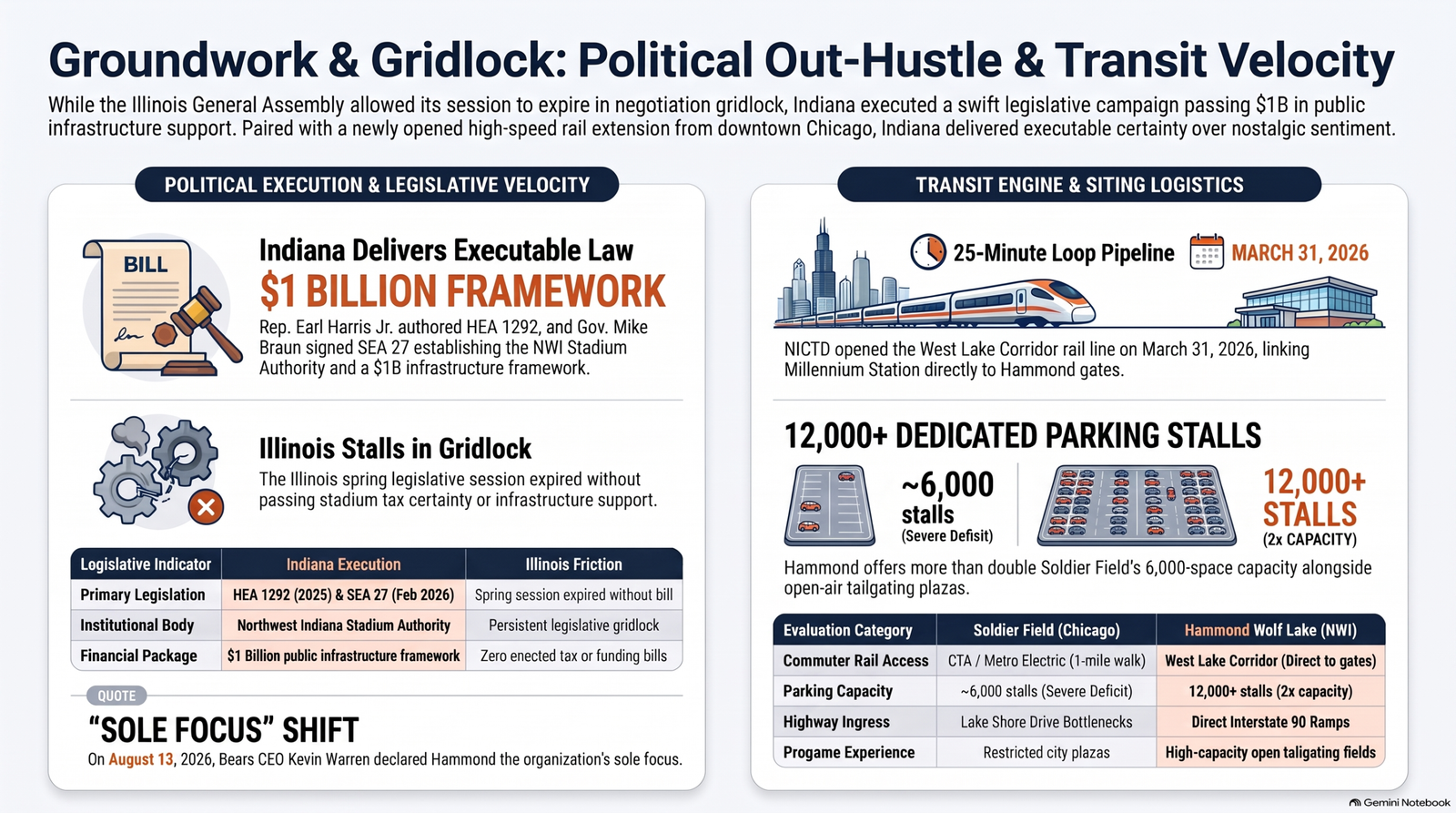
Indiana passed two laws and put about $1 billion on the table. Illinois passed two bills that went nowhere. Then, in November, the Bears reopened the door.
Choose your format
READ
The article · 3 min
WATCH
Video edition · 5 min
SEE
Full-size infographic · free download
LISTEN
Podcast · 5 min
THE RESEARCH
Slide deck + full report · skip ahead
Stadium fights get sold as love stories: tradition, the lakefront, a century of Sundays. This one is mostly about paperwork. Whoever gets a signed law, a funding plan and a buildable site first holds the ball.
For most of 2026, that was Indiana. Lawmakers in Indianapolis wrote the rules and funded the offer while Springfield argued with itself. My research calls it the political out-hustle. The fall has made it a closer game.
STATUS CHECK · AS OF NOV. 9, 2026
On Aug. 13, the Bears called Hammond their “sole focus.” On Nov. 6, a new team statement said they’re still “finalizing due diligence details across two sites in the Wolf Lake area,” but also “appreciate the recent engagement from Illinois leadership to explore legislation” and “expect productive dialogue with both leadership teams in the coming weeks.” Illinois lawmakers return Nov. 17–19 and Dec. 1–3.
FEB. 2026
Indiana signs SEA 27 into law
~$1B
In incentives in Indiana’s stadium framework
2 BILLS, 0 LAWS
Illinois’ spring session
$945M
Budget for the new Monon Corridor rail line
Indiana's fast break
Indiana started early. In 2025, Rep. Earl Harris Jr. of East Chicago wrote House Enrolled Act 1292, which created the Northwest Indiana Professional Sports Development Commission. It carried on a push by his late father, Rep. Earl Harris Sr., who championed bringing the Bears to Northwest Indiana.
Then came the big one. In February 2026, Gov. Mike Braun signed Senate Enrolled Act 27, creating the Northwest Indiana Stadium Authority. “We made it clear from the beginning that Indiana is open for business,” Braun said.
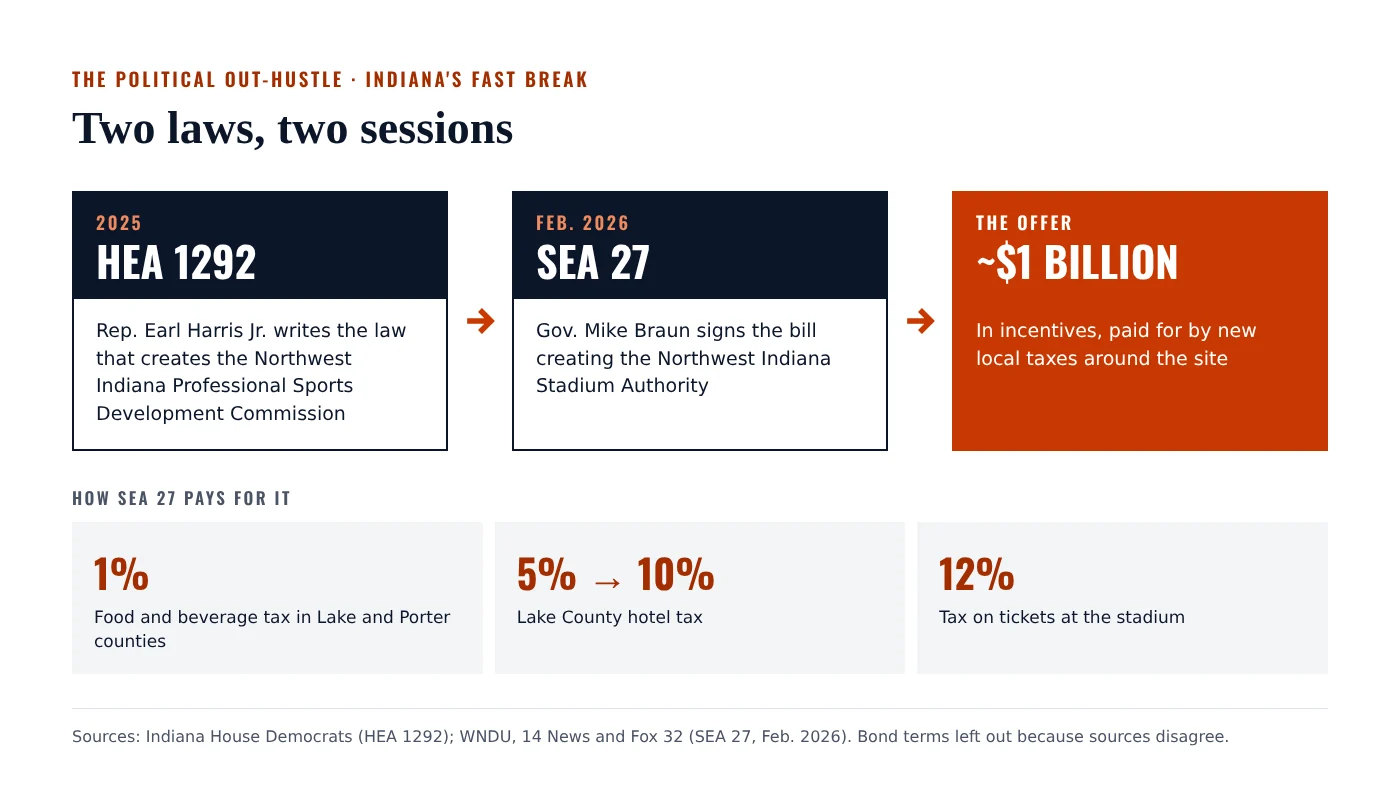
The bill puts about $1 billion in incentives on the table, paid for with new local taxes: a 1% food and beverage tax in Lake and Porter counties, Lake County’s hotel tax doubling from 5% to 10%, and a 12% tax on tickets at the stadium. The Bears told lawmakers they’d put in $2 billion of their own, WNDU reported.
Springfield's split decision
Illinois didn’t sit still. It just couldn’t finish. On April 22, the House passed a “megaprojects” property-tax bill 78–32. It died in the Senate.
On June 1, the Senate passed a different bill, built around a stadium authority, 37–17. The House adjourned without voting on it. Two chambers, two bills, zero laws.

Senate President Don Harmon summed up the mood: “There was no appetite at all to provide public dollars to a $10 billion sports franchise.” And the Arlington Park tax fight that started all this still had no long-term fix from Springfield.
Indiana sent the Bears a signed law. Illinois sent two bills that passed each other in the hallway.
| INDIANA | ILLINOIS | |
|---|---|---|
| Law on the books | HEA 1292 (2025) and SEA 27 (Feb. 2026) | None yet |
| Stadium body | Northwest Indiana Stadium Authority | Proposed in the Senate bill; not passed |
| Money on the table | About $1 billion in incentives from local taxes | Senate President: “no appetite” for public dollars |
| Next move | Waiting on the team | Veto session, Nov. 17–19 and Dec. 1–3 |
Sources: WNDU, Fox 32, Indiana House Democrats, Daily Herald, CBS Chicago.
The transit pitch, minus the hype
Here’s the part of my research I’ve rewritten. Earlier versions promised a fast, direct train from downtown Chicago to the stadium gates. That isn’t what got built.
The South Shore Line’s new branch opened March 31, 2026. It was planned as the West Lake Corridor and now runs as the Monon Corridor, a $945 million line that branches south from Hammond Gateway to South Hammond, Munster Ridge and Munster/Dyer. It’s a real win for commuters in the two-one-nine. But no rail link to either Wolf Lake-area stadium site has been announced.
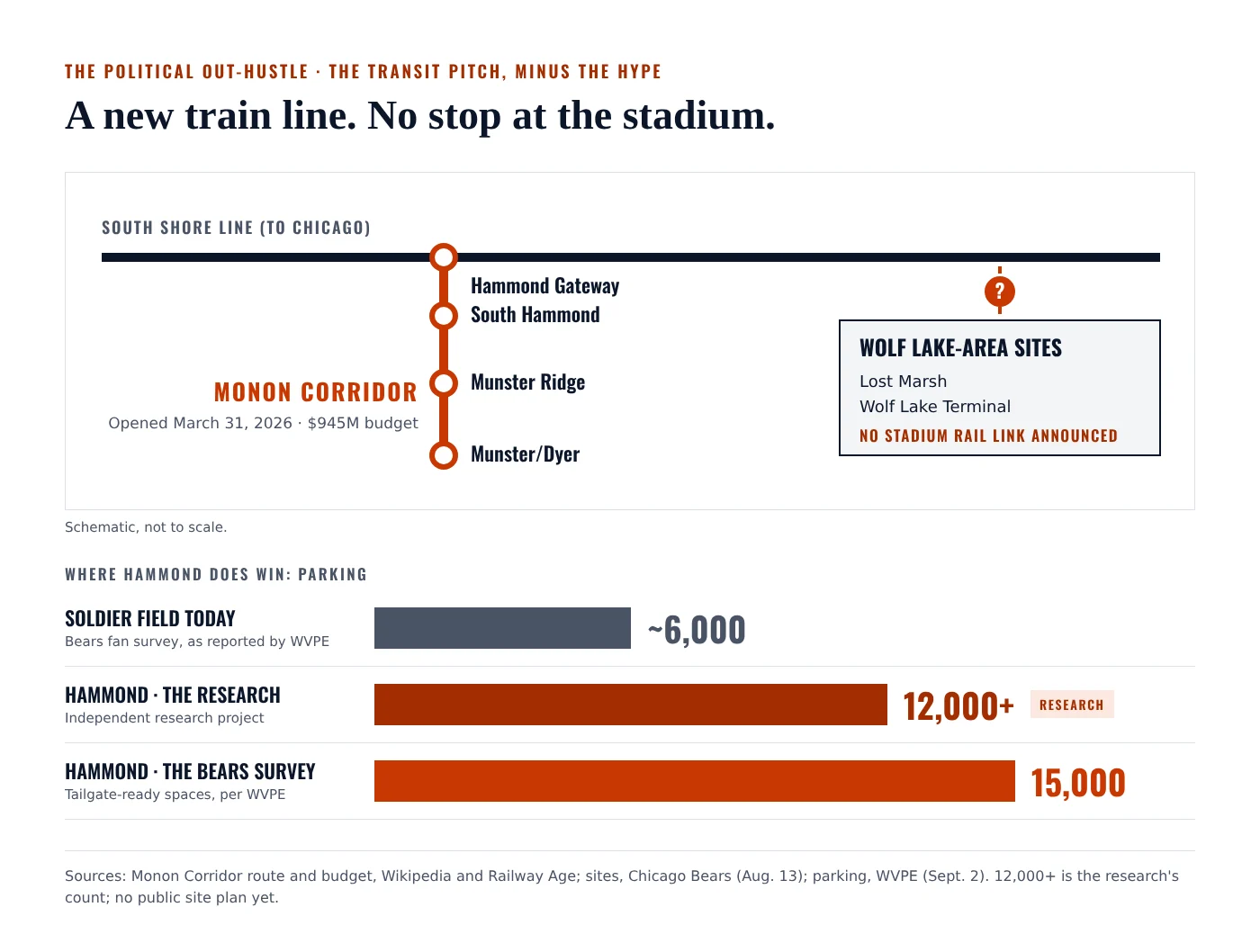
Where Hammond does win is the car-and-cooler crowd. Soldier Field has “roughly 6,000 parking spaces available today,” according to a Bears fan survey WVPE reported on in September. My research counted 12,000+ stalls near the Hammond sites; the same Bears survey describes 15,000 tailgate-ready spaces. Add direct I-90 ramps, and the game-day pitch writes itself.
From "sole focus" to "both leadership teams"
On Aug. 13, Bears President Kevin Warren made it plain: “Our sole focus at this point in time is working on a world-class stadium and mixed-use development in Hammond, Indiana.”
That focus covers two sites, not one. Lost Marsh is the golf course land where the team says its due diligence is finished. Wolf Lake Terminal is the second site it found along the way. “We have one site that works, Lost Marsh, and then to have another site is really unique,” Warren said.

Twelve weeks later, the tone changed. After Commissioner Roger Goodell, Chairman George McCaskey and Warren met with Illinois leaders, the team said it expects “productive dialogue with both leadership teams in the coming weeks” and has “a responsibility and obligation to explore every option available to the club.”
Indiana noticed. Gov. Braun’s office said “it is nearly time for the state to shift its energy and resources to the next opportunity.”
My read: Indiana’s speed won the first half. It turned a tax fight in Arlington Heights into a real two-state race and got Illinois back to the table. But a signed law isn’t a signed lease, and Springfield now has two sessions to show it can finish a bill.
Indiana got to yes first. Illinois gets one more possession.
THE VIDEO
Watch the video edition
The episode as a video, for anyone who would rather press play than scroll. It runs about 5 minutes.
THE PODCAST
How Indiana Stole the Chicago Bears
Podcast · about 5 min · MP3
The audio companion to this post. It was recorded before the latest updates, so the article has the current facts.
OVER TO YOU
Indiana moved first and put real money on the table. If Illinois finally passes a bill in the veto session, does speed still win, or does the home team get the last word?
UP NEXT
The Geotechnical Gauntlet: The Dirt Doesn't Lie
Above ground, Hammond looks like a tailgater’s dream. Below ground, it’s a different story.
THE RESEARCH DESK
Show me the receipts.
This post is the fan-facing cut of an independent urban-planning research project. Here’s the full presenter deck and research report for anyone who wants the methodology, sources and numbers behind it.
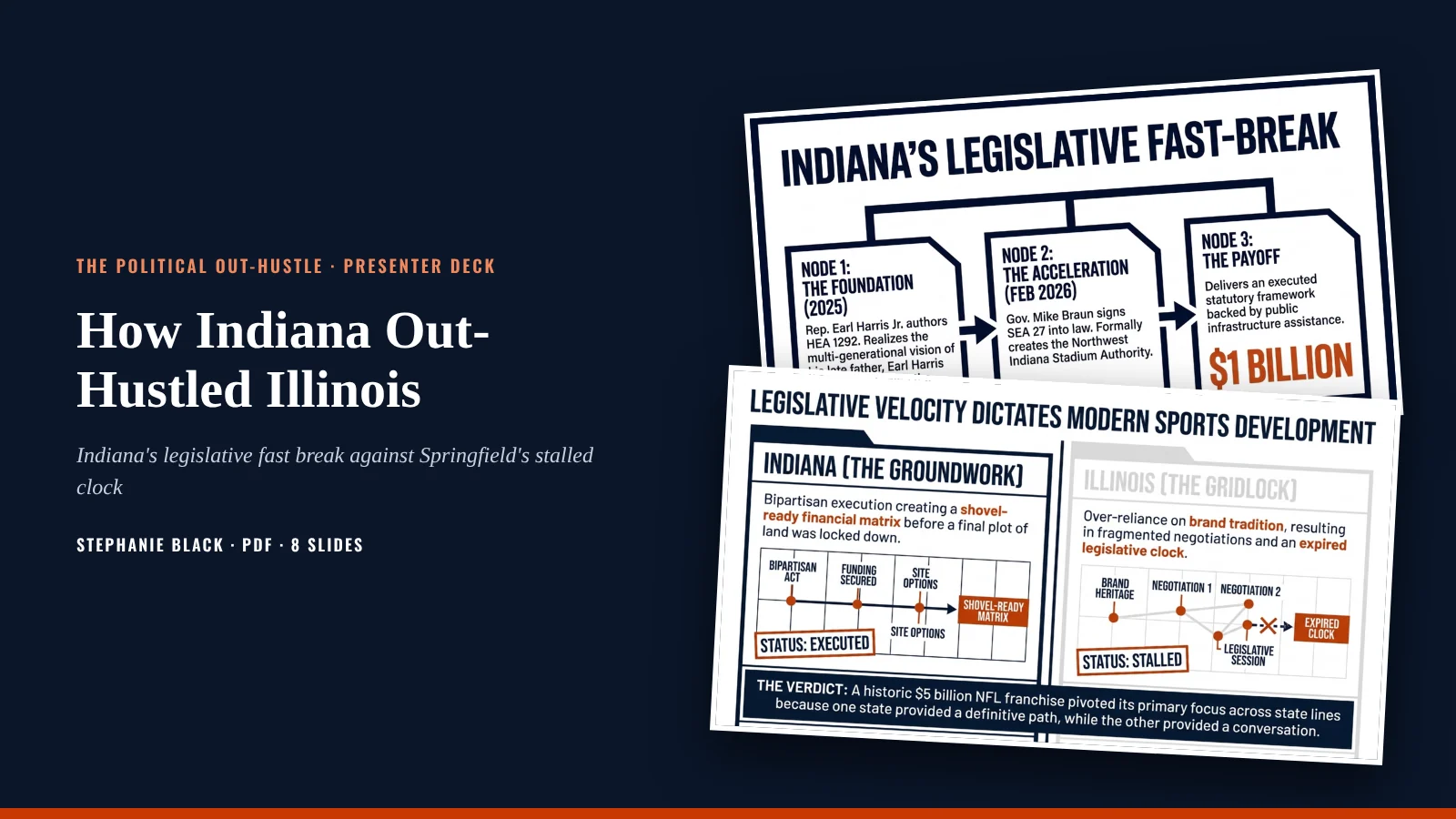
PRESENTER SLIDE DECK
How Indiana Out-Hustled Illinois
PDF · 8 slides

RESEARCH REPORT
Indiana's Interstate Arbitrage for the Chicago Bears Relocation
PDF · 13 pages
WHAT'S IN THE RESEARCH
- Legislative speed vs. Springfield gridlock
- HEA 1292 and SEA 27
- The Arlington Park tax standoff
- Transit and highway access
- Soldier Field vs. Hammond footprint
- Public financing, fiscal risk and the three strategic paths
METHODS & SOURCES
- Public reporting, team statements and Indiana stadium legislation (HEA 1292, SEA 27)
- Compares Indiana and Illinois on laws passed, funding, transit, parking and timing
- Parking counts, revenue projections and the strategic paths are research estimates
- Read the full report →
CITE THIS RESEARCH
Black, S. (2026, November). Groundwork & Gridlock: A diagnostic research report on Indiana’s interstate arbitrage for the Chicago Bears relocation [Research report]. CreativeTech Studio. https://creativetech.studio/wp-content/uploads/2026/11/Groundwork-Gridlock-Research-Report-1.pdf

Stephanie Black
Urban planner and independent analyst from Crown Point, Indiana. Commutes into the Loop on I-90 and the South Shore Line, and audits stadium hype against the dirt, the statutes and the bond math.
