

Groundwork & Gridlock · The Franchise Ledger
The Franchise Ledger: What Every Chicago Bears Stadium Option Costs the Team
Arlington Heights, Hammond, Illinois' stadium-authority idea and South Works, read from the Bears' side of the balance sheet.
Choose your format
The article · 6 min
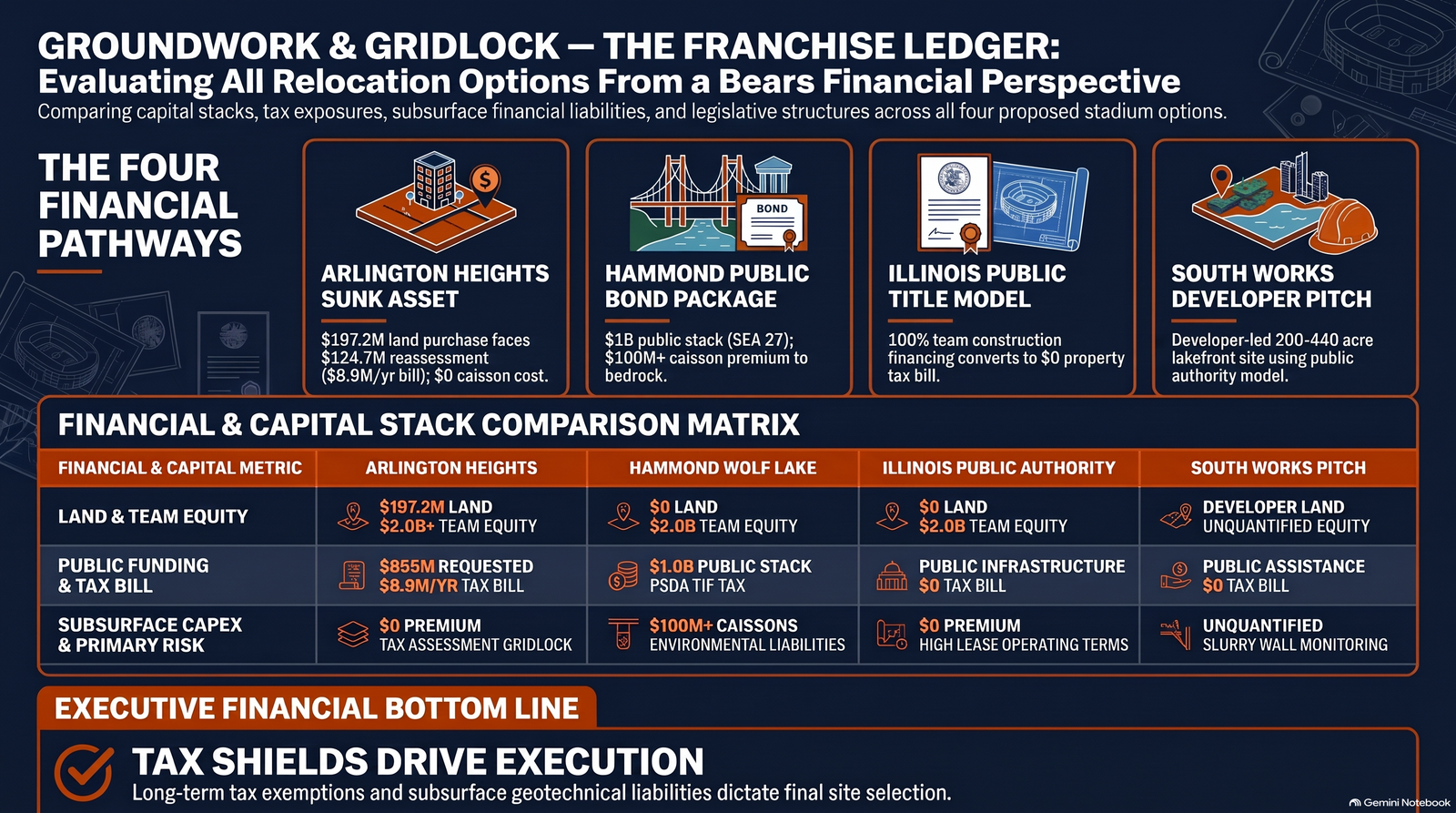
Full-size infographic · free download
Podcast with Steph & Matt · 5:44
Slide deck + full report · skip ahead
Every stadium fight gets told as a story about fans, politicians and maps. The Bears are a business, though, and a business looks at a site the way you’d look at a house: what you’ve already paid, what someone else will cover, and what the bills look like for the next 30 years.
So this time I’m setting the geography aside. Four Chicago Bears stadium options have been on the table in my research: the land the team already owns in Arlington Heights, Indiana’s package at Wolf Lake in Hammond, Illinois’ new stadium-authority idea, and a developer pitch for the old U.S. Steel South Works site. Here’s how each one looks from the team’s chair.
STATUS CHECK · AS OF NOV. 22, 2026
Illinois’ fall veto session opened Nov. 17 with no vote on a Bears bill. Rep. Kam Buckner says it’s “on track” for Dec. 1–3. Bears leaders briefed the NFL’s stadium committee this week. Indiana’s law has been on the books since February, and the Bears’ last public word (Nov. 6) said they’re still finalizing due diligence on two Wolf Lake sites.
$197.2M
Land the Bears already bought in Arlington Heights
$2B
What the Bears have pledged to put into a stadium
~$1B
Indiana’s public money for the Hammond project
$855M
Public infrastructure the Arlington plan called for
The asset they already own: Arlington Heights
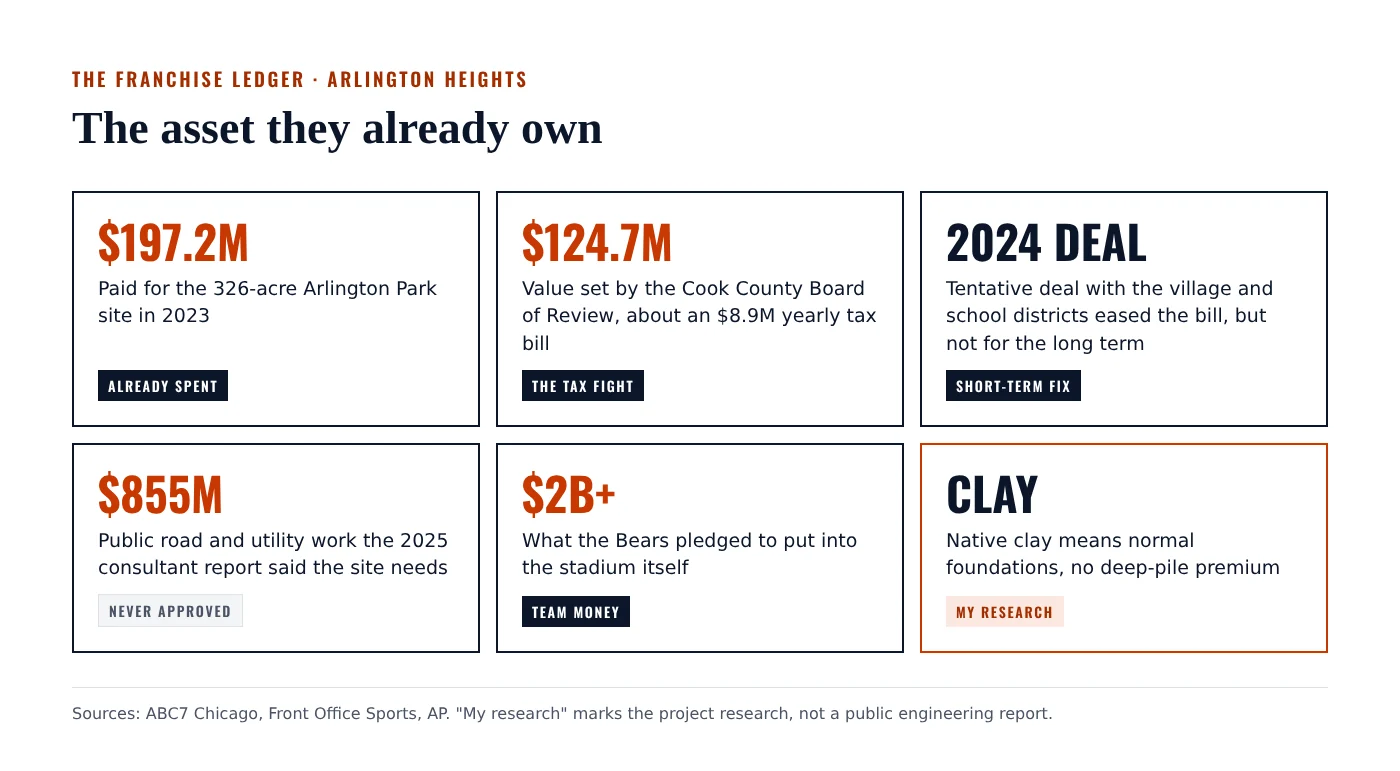
The Bears paid $197.2 million for the old Arlington Park in 2023. That money is spent either way, which is why economists call it a sunk cost. It still shapes every decision after it.
On the plus side, my research found native clay under that site, which means a normal foundation and no deep-pile premium. On the minus side is the tax fight that started all this. The Cook County Board of Review set the property at $124.7 million, which works out to roughly an $8.9 million annual bill. A tentative 2024 deal with the village and school districts eased that, but it never gave the team the long-term certainty it wanted.
Then there’s the infrastructure. The Bears’ own consultant report in 2025 said the site needs $855 million in public road and utility work around a stadium the team pledged more than $2 billion to build. Springfield never approved it.
The public stack: Hammond and Wolf Lake
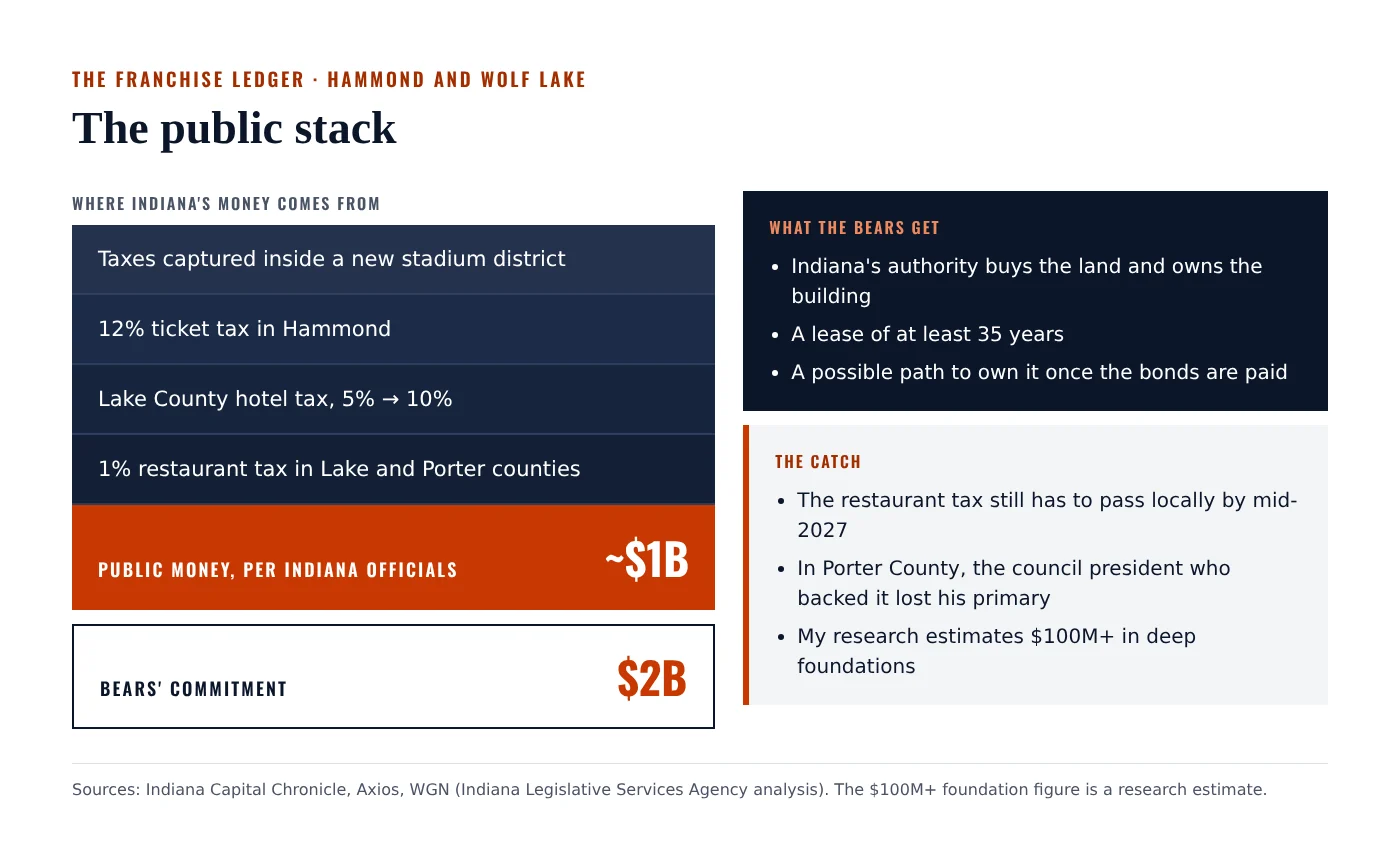
Indiana did what Illinois wouldn’t: it put a number on the table and passed it into law. The Bears have committed $2 billion. Indiana officials say public money could top $1 billion, paid back by a 12% ticket tax in Hammond, Lake County’s hotel tax going from 5% to 10%, a 1% restaurant tax in Lake and Porter counties, and taxes captured inside a new stadium district.
Here’s the part that matters to a CFO: Indiana’s authority would buy the land and own the building. The Bears would sign a lease of at least 35 years with a possible path to own it once the bonds are paid. In plain terms, no land bill and no property-tax fight.
Indiana didn't just make an offer. It took the land bill and the tax bill off the Bears' desk.
The catch is underground and in the county councils. My research estimates more than $100 million in deep foundations to reach bedrock through slag, refinery fill and peat. And the restaurant tax still has to pass locally by mid-2027. In Porter County, the council president who backed it lost his primary.
The tax shield: Illinois' stadium-authority idea
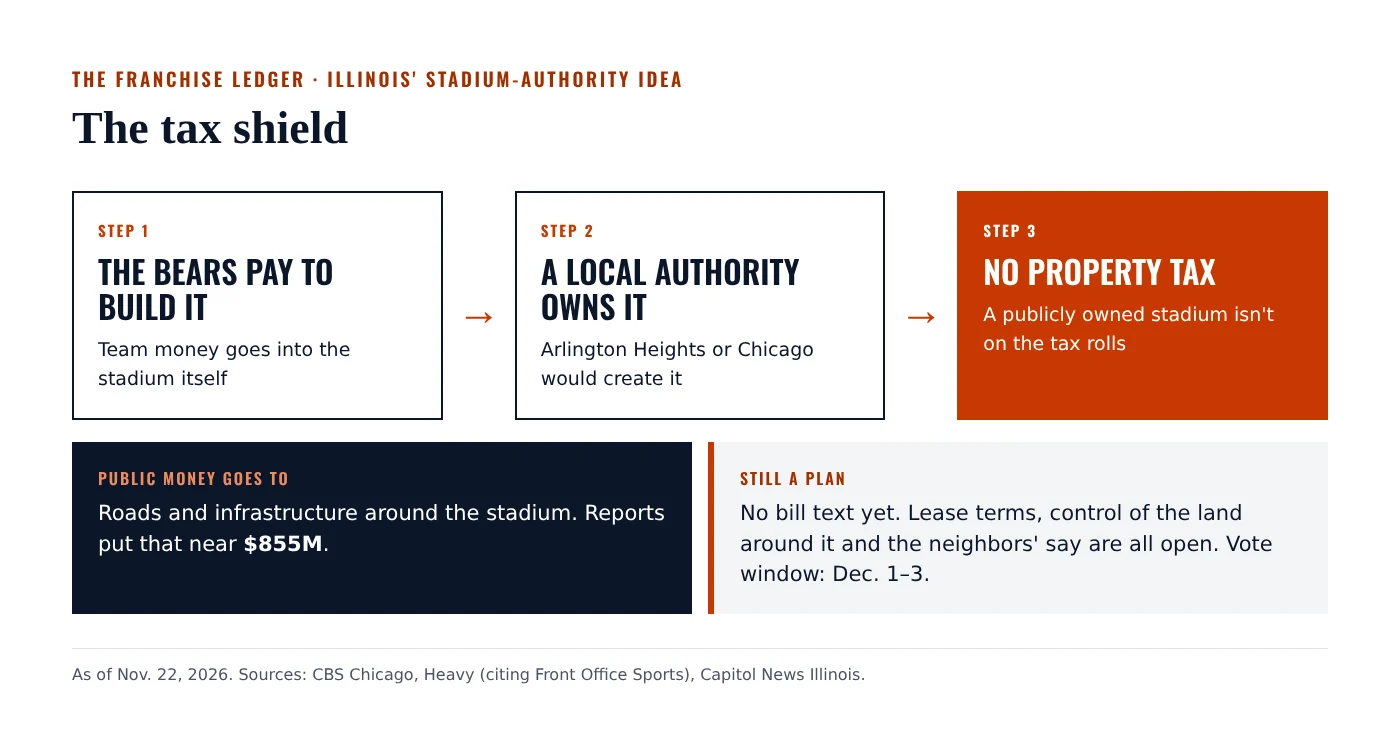
Illinois’ answer copies the trick that makes Indiana’s deal work. Under the plan being negotiated, Arlington Heights or Chicago would create an authority that owns the stadium. The Bears would pay to build it, public money would go to roads and infrastructure (reports put that near $855 million), and because the public owns it, there’s no property tax. That idea came back this fall after dying in the spring.
For the Bears, that turns the biggest liability at Arlington, the tax bill, into a zero, while keeping the clay and the land they already paid for. On paper, that’s the best line in my research for the team’s balance sheet.
But it’s still a plan, not a law. There’s no bill text yet, and nobody knows the final lease terms, who controls the district around the stadium, or how the neighbors fit in. Palatine and Rolling Meadows already want a say.
The wildcards: South Works and the rest of Chicago
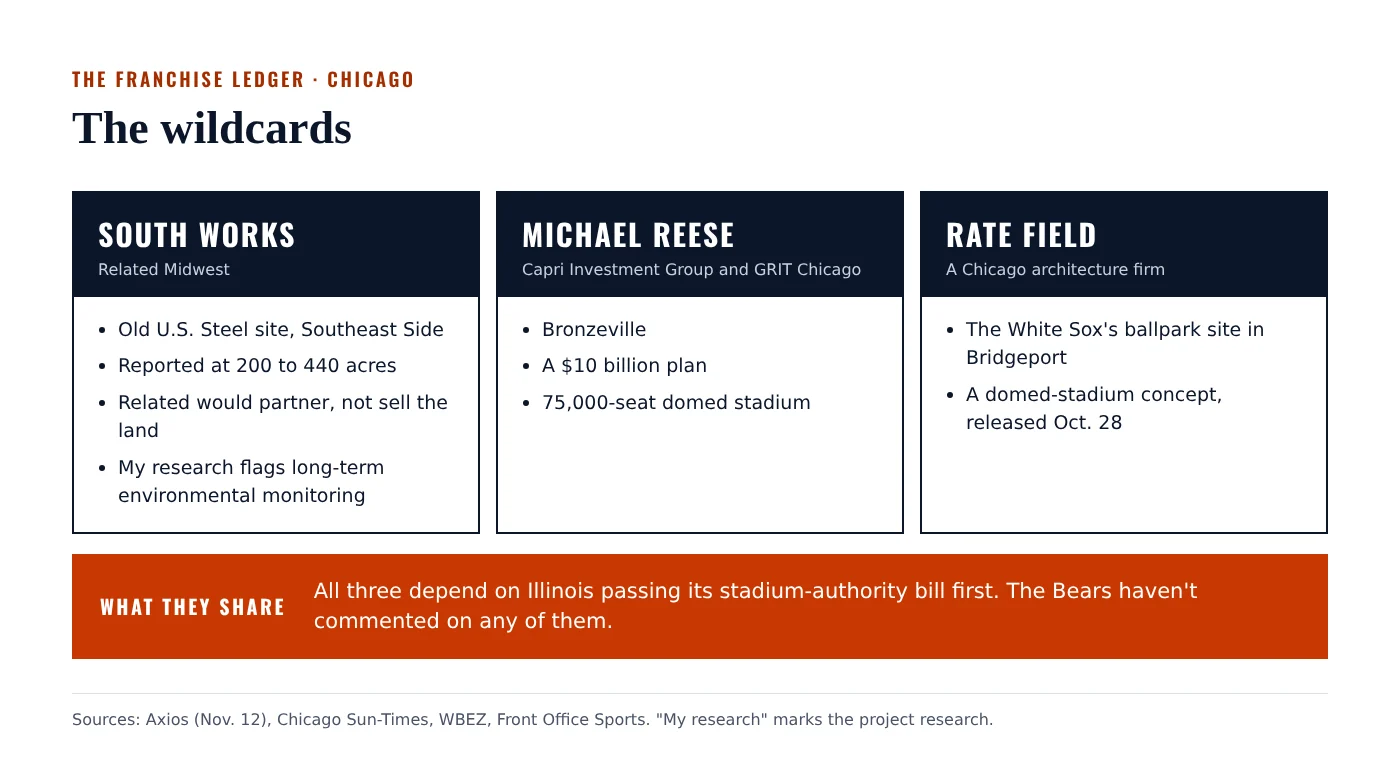
Related Midwest pitched the old U.S. Steel South Works site on the Southeast Side, with reports putting it at 200 to 440 acres. Related says it would partner with the Bears rather than sell them land. For a team that wants to own its upside, that’s a problem: shared ground usually means shared profit.
It’s also former steel mill land, and my research flags long-term environmental monitoring as an unpriced risk. Two more Chicago pitches showed up this fall: a $10 billion Michael Reese plan in Bronzeville built around a 75,000-seat dome and a concept at the White Sox’s Rate Field. The Bears haven’t commented on any of them, and all three would depend on Illinois passing its authority bill first.
The ledger, side by side
| ARLINGTON HEIGHTS | HAMMOND / WOLF LAKE | ILLINOIS AUTHORITY | SOUTH WORKS | |
|---|---|---|---|---|
| Land | $197.2M, already paid | Bought by Indiana’s authority | Depends on the town; already owned at Arlington | Developer’s land, partnership |
| Bears’ stadium money | $2B+ pledged | $2B committed | Bears pay to build | Not public |
| Public money | $855M infrastructure ask, never approved | ~$1B, in law | Infrastructure, reported near $855M, no bill yet | Not public |
| Property tax | $124.7M assessment, ~$8.9M bill | None on a publicly owned stadium | None on a publicly owned stadium | Would use the same authority |
| Ground risk | Clay, normal foundations | My research: $100M+ deep foundations | Clay if at Arlington | My research: long-term monitoring |
| Biggest open question | Can the tax be fixed? | Will counties pass the taxes? | Will a bill pass Dec. 1–3? | Will the Bears even look? |
The bottom line
My read: both finalists now end in the same place. A public owner, a long Bears lease and no property-tax bill. So the real balance-sheet fight isn’t the stadium anymore. It’s everything around it: who pays for the roads, who owns the land next door, and who eats the cost of what’s under the dirt.
The building is the easy part. The ground and the roads are what cost money.
SOURCES
- Capitol News Illinois: Bears bill “on track” for Dec. 1–3
- ABC7 Chicago: Bears seek $855M for infrastructure
- Indiana Capital Chronicle: the stadium bill’s tax math
- Indiana Capital Chronicle: Porter County splits on the taxes
- WGN: the Hammond lease and path to ownership
- CBS Chicago: how the Illinois authority would work
- Axios: the South Side stadium pitches
THE PODCAST
The Franchise Ledger
Steph (NWI-native planner) and Matt (Chicago urbanist) run the numbers on every Bears stadium option, from the team’s side of the table.
THE INFOGRAPHIC
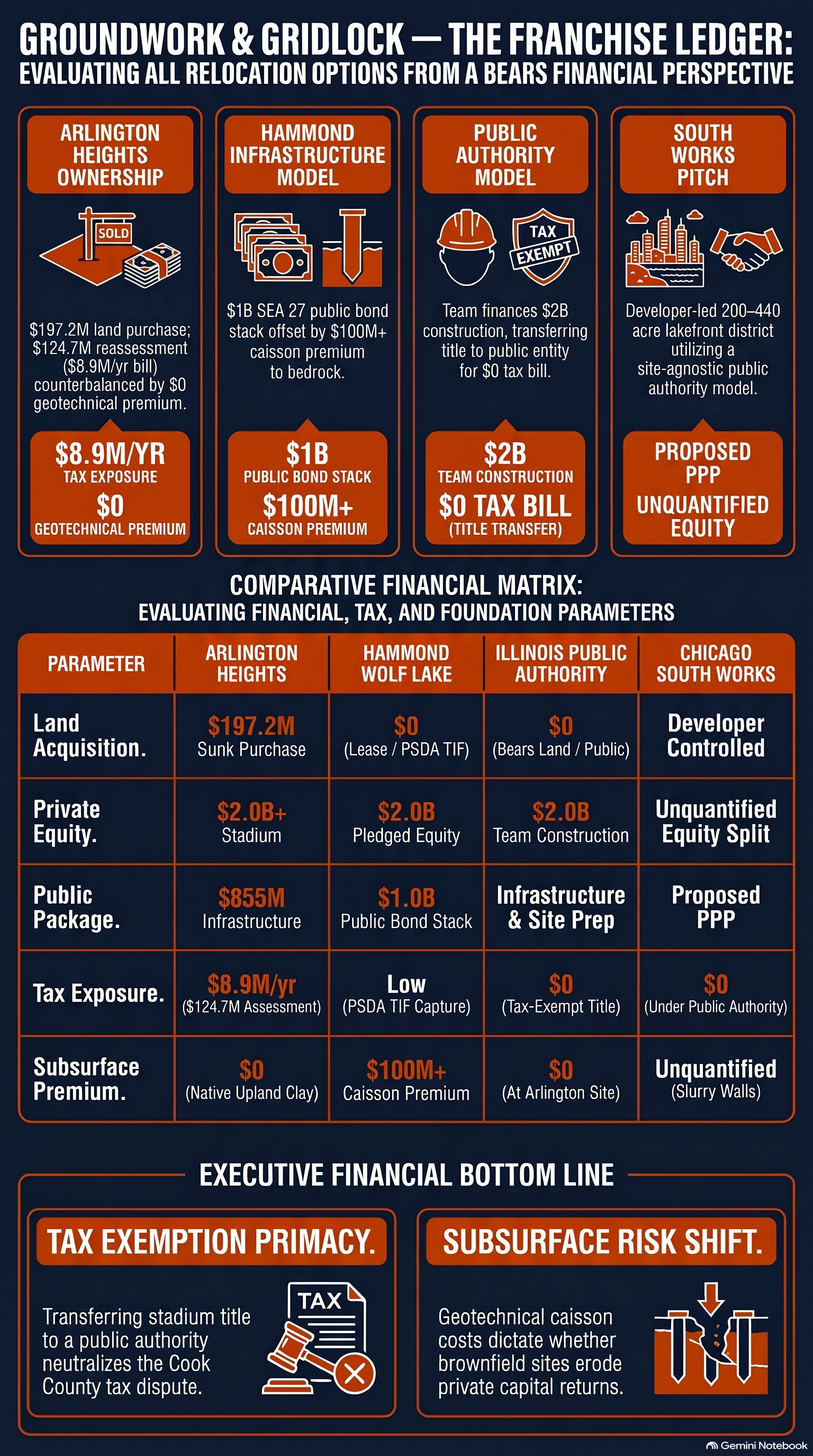
The phone-size version
The same ledger, stacked top to bottom so it reads on a phone. Built for a story, a text thread or a quick look before kickoff.
PNG · portrait · 1536 × 2752
OVER TO YOU
If you were the Bears' CFO, which line would you fix first: the tax bill, the dirt or the land you don't own?
Start from the top: The Political Out-Hustle
NEW TO THE SERIES?
THE RESEARCH DESK
Show me the receipts.
This post is the fan-facing cut of an independent urban-planning research project. Here’s the full presenter deck and research report for anyone who wants the methodology, sources and numbers behind it.
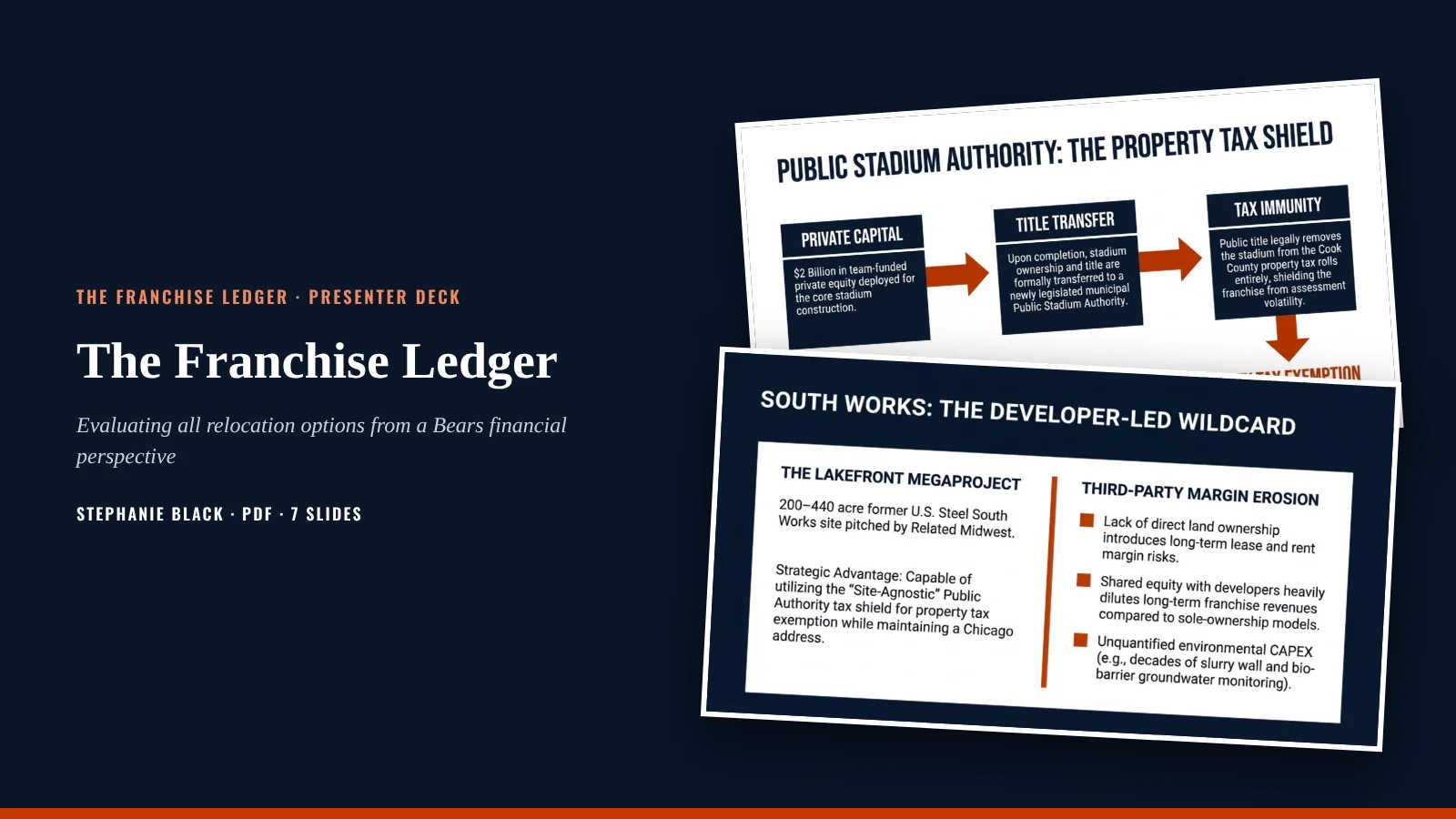
PRESENTER SLIDE DECK
The Franchise Ledger: Evaluating All Relocation Options From a Bears Financial Perspective
PDF · 7 slides
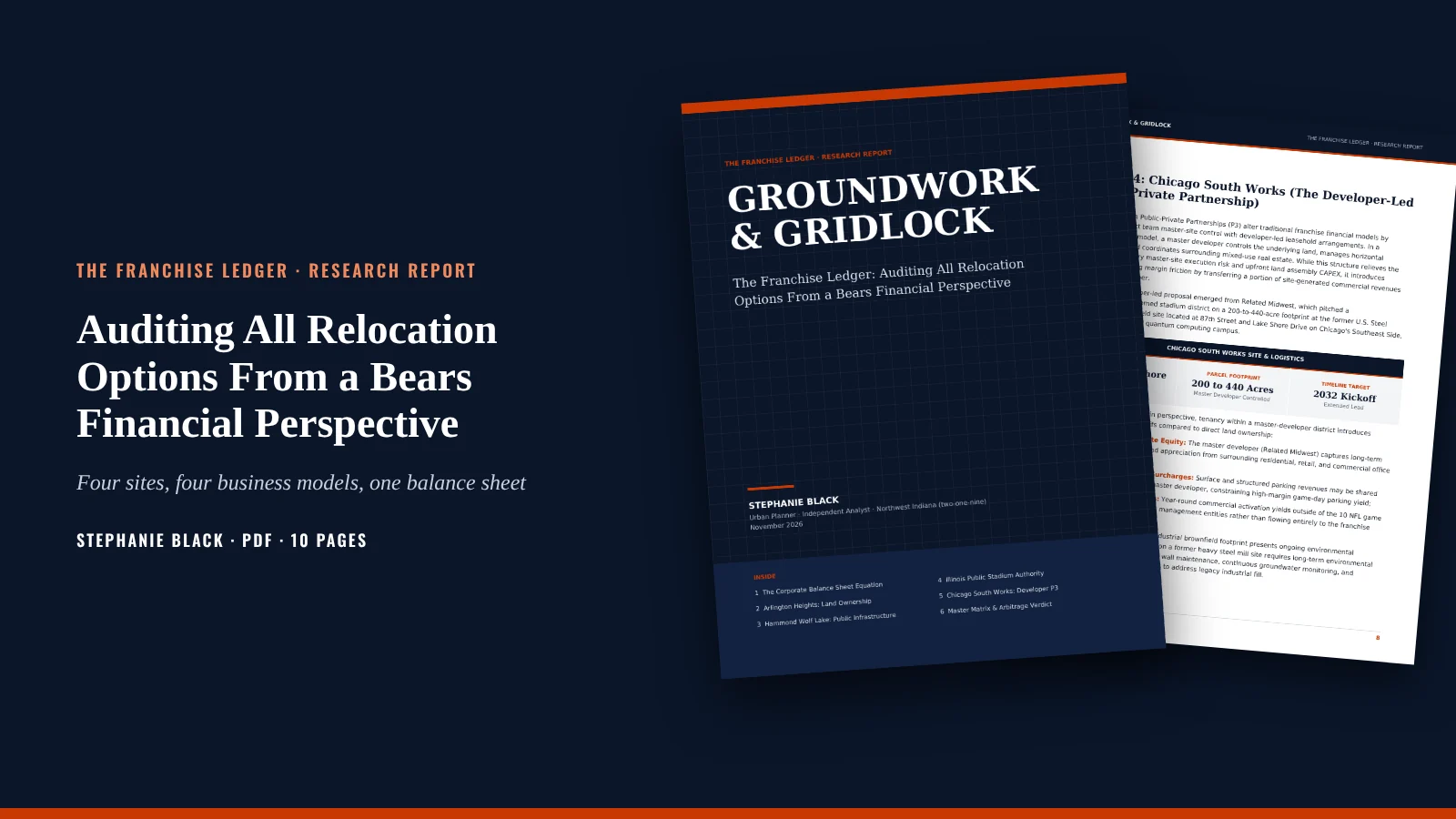
RESEARCH REPORT
The Franchise Ledger: Auditing All Relocation Options From a Bears Financial Perspective
PDF · 10 pages
WHAT'S IN THE RESEARCH
- Arlington Heights land ownership and the property tax fight
- Hammond’s SEA 27 public stack and foundation costs
- Illinois’ public stadium authority and leaseback model
- The South Works developer-led partnership
- A master financial matrix across all four sites
METHODS & SOURCES
- Compares four site options on land, team capital, public money, property tax and foundation risk
- Draws on public reporting, Indiana’s SEA 27 framework and the project’s geotechnical research
- Where the post and the research differ, the post reflects reporting through Nov. 22, 2026
- Read the full report (PDF) →
CITE THIS RESEARCH
Black, S. (2026). Groundwork & Gridlock: The Franchise Ledger. CreativeTech Studio. [URL]
Stephanie Black
Urban planner and independent analyst from Crown Point, Indiana. Commutes into the Loop on I-90 and the South Shore Line, and audits stadium hype against the dirt, the statutes and the bond math.