
gvch
A fuel distributor, a pickle maker and an engineer show what’s possible when AI takes over the busywork. Then we translate each win into a local HVAC shop.
AI for Small Business Series · Part 2 of 4
In Part 1, we looked at the data: most small businesses are just getting started with AI, and it’s never been cheaper to begin. Now let’s look at what happens once you do.
Goldman Sachs recently surveyed nearly 2,500 small business owners who completed its 10,000 Small Businesses program. More than 85% use AI in some form, and 42% now use it for financial analysis and planning, more than double the share in 2024.
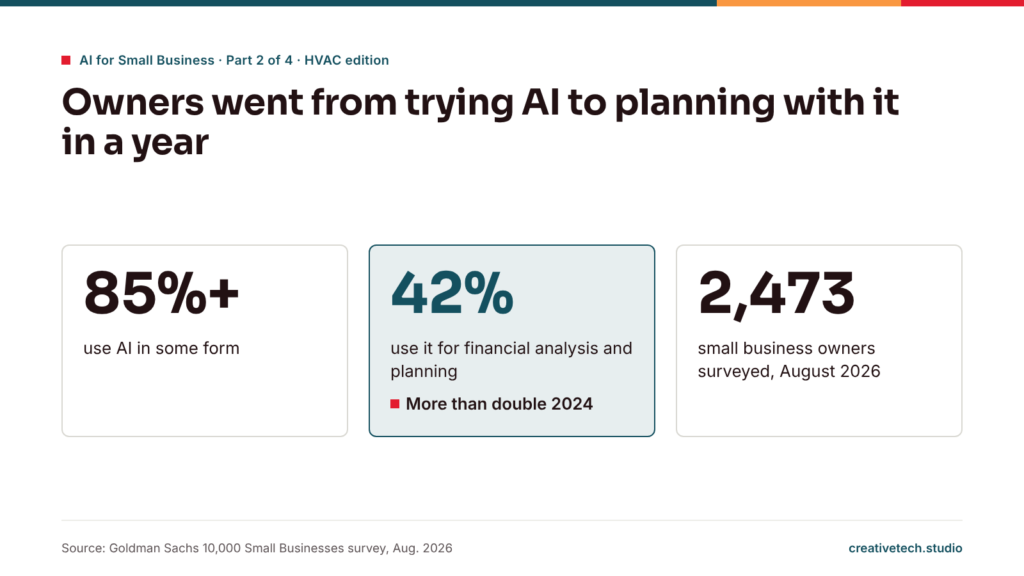
That jump happened in a single year. Plenty of these owners didn’t start out ahead. They picked AI up recently, one task at a time.
Below are three of their stories. After each one, I’ll show what the same idea could look like at our running example, Rearick’s Heating & Cooling, a Merrillville HVAC company that’s been serving Northwest Indiana since 1937. (These Rearick’s scenarios are illustrations, not a description of how the company runs today.)
1. The fuel distributor who turned email help into a growth plan
Marie Hunter runs KRG Oil Company, a small family fuel business outside Atlanta. She and a colleague built a simple AI agent, and its first job was humble: helping manage her email.
Once that was saving her time, she gave it bigger jobs, like analyzing finances and drafting growth plans. When her team wanted to price out solar panels for a handful of fuel tanks, the AI came back with something better: a plan for a whole new product line with add-on services.
Hunter calls it her force multiplier. It started with the inbox.
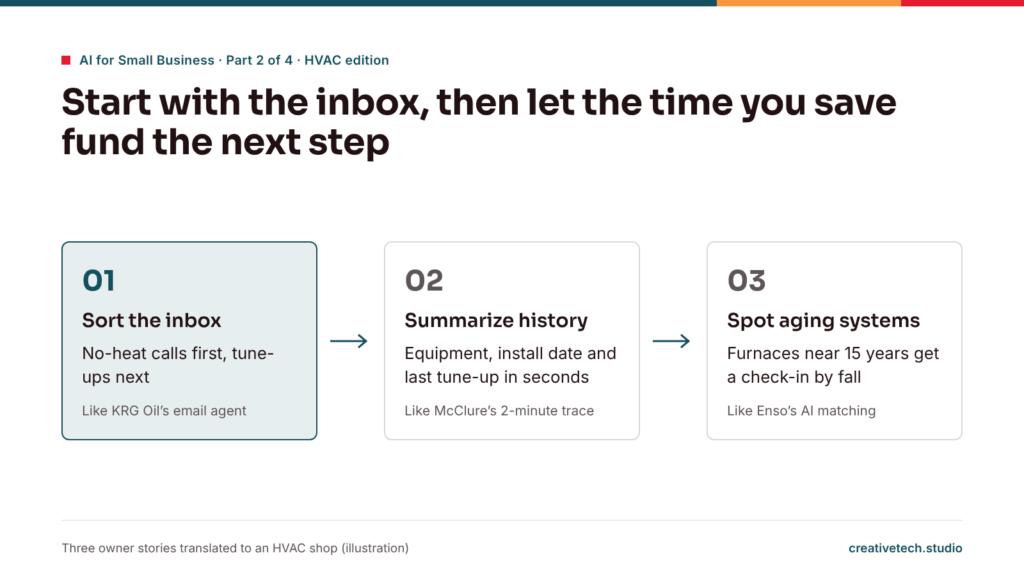
The Rearick’s version: Start with the overnight inbox and voicemail. An AI assistant could sort incoming messages before the office opens at 8: no-heat emergencies at the top, tune-up requests next, filter orders and general questions after that. Once that saves real time, the same assistant could help answer a bigger question, like which add-on services (air purification, humidifiers, smart thermostats) customers keep asking about.
Start with the task that bugs you most. The bigger wins tend to follow once you’ve freed up the time.
2. The pickle maker who turned a 45-minute task into 2 minutes
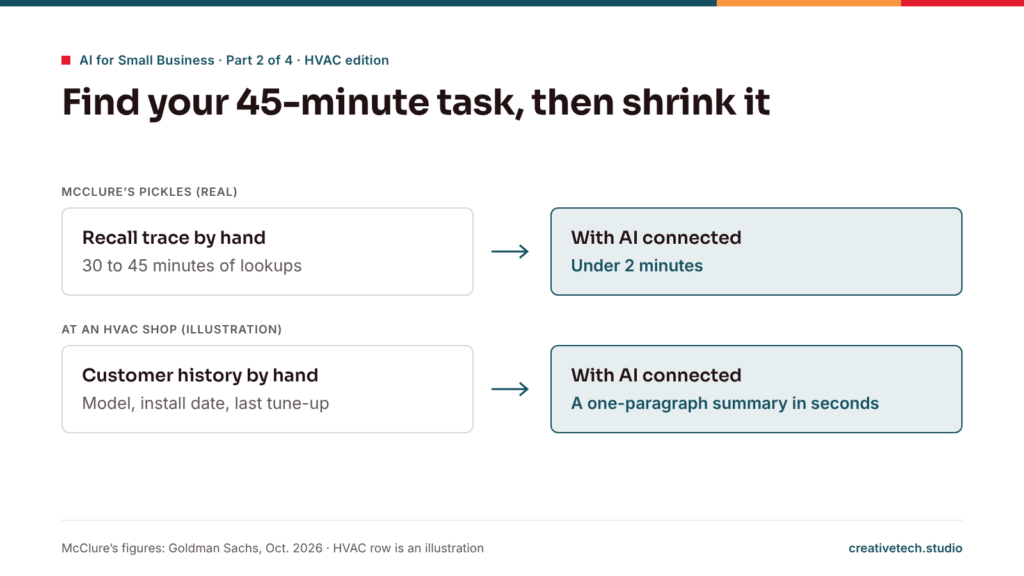
McClure’s Pickles in Detroit makes more than 3 million jars a year, and food safety comes first. The company regularly practices tracing ingredients in case of a recall. That used to mean 30 to 45 minutes of manual lookups.
Co-owner Bob McClure connected AI tools to the company’s business software. Now a trace takes under two minutes. He’s since built AI helpers that watch the equipment, draft supplier bills and double-check jar labels.
Here’s the best part: McClure is a former actor with no coding training. He tells the AI what he needs in plain English. It sometimes takes a few tries to get the instructions right, but he does it himself, without hiring a programmer.
The Rearick’s version: Every HVAC office has its own 45-minute task. Before calling a customer back, someone may need to dig up the equipment model, install date, last tune-up and any open warranty. If that history lives in the company’s service software, an AI tool connected to it could pull a one-paragraph summary in seconds. The technician walks in prepared, and the customer doesn’t have to repeat their story.
3. The engineer who let AI spot what her team couldn’t
Naomi Stone runs an environmental engineering firm in California. She launched a new venture, Enso, that uses AI to match companies sitting on leftover materials with buyers who can use them.
Matching that many buyers and sellers by hand would take her team ages. AI does it at a speed and scale they couldn’t manage alone, and it surfaces matches they hadn’t even considered. For her clients, a disposal cost becomes a new source of revenue.
The Rearick’s version: Rearick’s own site notes that a furnace typically lasts around 15 years. AI could scan years of service records to spot customers whose equipment is getting close to that age, or who have had repeat repairs. The team could reach out with a friendly check-in before a midwinter breakdown, not after. That’s better for the customer, and it turns a pile of old records into planned replacement work instead of emergency calls.
What you can borrow from them
- Start small on purpose. Hunter’s AI began with email. For an HVAC shop, that might be sorting overnight messages. Get one routine task off your plate, and let the saved time fund the next experiment.
- Hunt for your 45-minute task. Every business has a lookup, report or check that eats time every week. In the trades, it’s often pulling up a customer’s history or writing up an estimate.
- Plain English is enough. If a former actor can build AI helpers for a factory, a service manager can write a clear prompt. Expect a few rounds of tweaking. That’s normal, not failure.
- Ask AI what you’re missing. Once the busywork is handled, ask bigger questions: Which customers are overdue for a tune-up? Which repairs keep coming back?
- Stay in the driver’s seat. AI drafts, sorts and suggests. Your people review and decide, especially anything involving safety, pricing or a customer’s home.
The bottom line
None of these owners waited until they felt ready. They started with one annoying task, got time back, and built from there. The same path is open to a company like Rearick’s, and to yours. You’re not behind them; you’re just a few steps from where they began.
Next in the series, Part 3: A practical starter kit of AI tools that save small businesses the most time, with real examples from an HVAC front office, plus the guardrails that keep you out of trouble.
Follow along for the rest of the series, and share in the responses: what’s your 45-minute task?
Source: Goldman Sachs, “How Small Business Owners Are Using AI to Help Propel Growth” (Oct. 22, 2026), and the 10,000 Small Businesses report “The AI Economy is a Small Business Economy.” Survey of 2,473 program alumni, conducted by Babson College, Aug. 10–24, 2026. https://www.goldmansachs.com/insights/articles/how-small-business-owners-are-using-ai-to-help-propel-growth. Business details from rearicksnwi.com.
Medium publishing notes (don’t publish this section)
- Before publishing: Confirm Rearick’s is comfortable with the scenarios. If they keep records somewhere specific (a field service app, spreadsheets, paper), you could tailor the 45-minute example to match.
- Title: These Small Business Owners Got Hours Back With AI. Here’s What That Could Look Like at Rearick’s.
- Subtitle: Set the italic line under the title as the subtitle.
- Tags (pick 5): Small Business, Artificial Intelligence, HVAC, Productivity, Automation
- SEO title: How Small Businesses Save Time With AI (and an HVAC Example)
- SEO description: Three owners show how AI saves hours, and how each win could work for a local HVAC company. Start with your own busiest task.
- Canonical link: If it ran on creativetech.studio first, import it or set the original URL in advanced settings.
- Featured image: A technician at a furnace or a front-office desk. Don’t use the owners’ photos from the Goldman Sachs article; use Rearick’s photos only with permission.
- Pull quote: “Start with the task that bugs you most…”
- Graphics: The “45 minutes → under 2 minutes” graphic still fits under the pickle maker story.
- Read time: About 6 minutes.