

hjbkjb
Ready-to-use prompts, a quick fit test and back-of-the-napkin payback math, using a local heating and cooling company as the example.
AI for Small Business Series · Part 4 of 4
You’ve made it to the final part of the series. By now you know most small businesses are just getting started (Part 1), real owners are already winning back hours (Part 2), and there are five easy places to begin (Part 3).
So here’s the last question, and it’s the one that saves you from wasted effort: which task should you hand to AI first?
The answer isn’t “whatever’s trendy.” It’s the task where checking AI’s work takes less time than doing the job yourself. This guide, inspired by a practical playbook from Perplexity, shows you how to find it, one more time using our running example, Rearick’s Heating & Cooling in Merrillville, Indiana. (As throughout the series, the Rearick’s scenarios are illustrations, not a description of how the company runs today.)
Where AI saves the most time
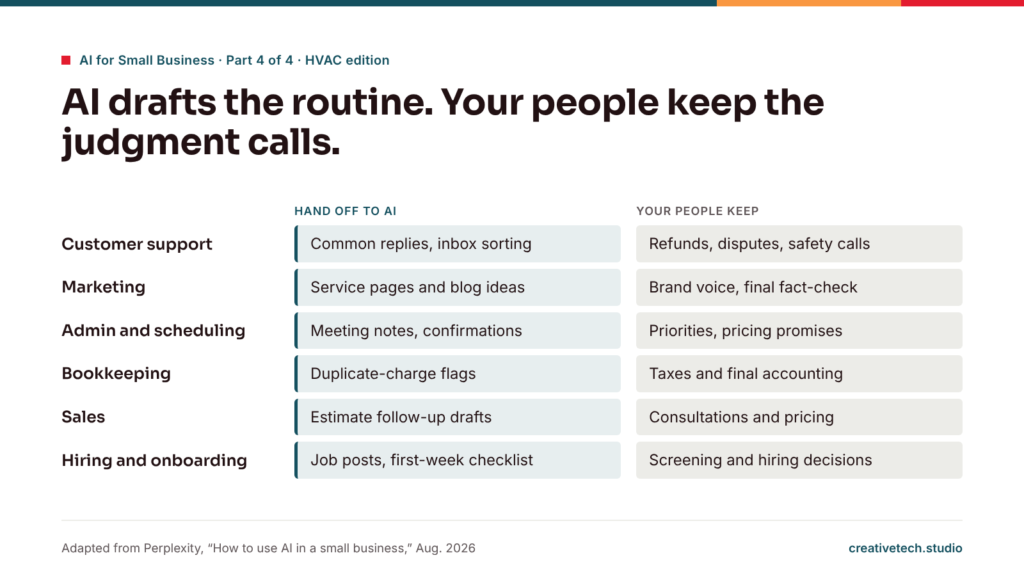
These six areas eat the most hours in a typical small business. For each one, here’s what to hand off and what to keep, with an HVAC example:
- Customer support. Let AI draft replies to common questions, sort the inbox and flag urgent messages, like putting no-heat calls at the top. Keep refunds, disputes, safety calls and upset customers for your people.
- Marketing. Let AI draft service pages, turn customer questions (“Why is my furnace short-cycling?”) into blog ideas and spot gaps on your site. Keep your brand voice and the final fact-check.
- Admin and scheduling. Let AI summarize team meetings, draft appointment confirmations and catch scheduling conflicts. Keep priorities, deadlines and pricing promises.
- Bookkeeping. Let AI flag duplicate supplier charges and summarize cash flow through the slow months. Keep taxes and final accounting calls with you and your accountant.
- Sales. Let AI find estimates nobody followed up on and draft personal follow-ups. Keep the in-home consultation, pricing and relationship-building.
- Hiring and onboarding. Let AI draft job posts, interview questions and a first-week checklist for a new technician. Keep screening and hiring decisions human.
Copy-and-paste starter prompts
A good prompt names three things: what to look at, what to produce, and what not to do. Here they are, written for an HVAC office:
For the inbox: “Read these customer emails and our FAQ. List the top recurring questions, note any our FAQ doesn’t answer, and draft replies for the routine ones, like service areas, financing and tune-up scheduling. Don’t quote prices or promise appointment times. Flag anything about no heat, no cooling, gas smells or upset customers for a person.”
For the books: “Review this six-month transaction export. Flag possible duplicate supplier charges, unusual jumps and uncategorized expenses in a list. Don’t change any categories or give tax advice.”
For estimate follow-ups: “From these notes, list every replacement estimate we haven’t followed up on in two weeks. Draft a short, friendly check-in for each that mentions the equipment we discussed. Don’t mention pricing, discounts or send anything.”
The quick fit test
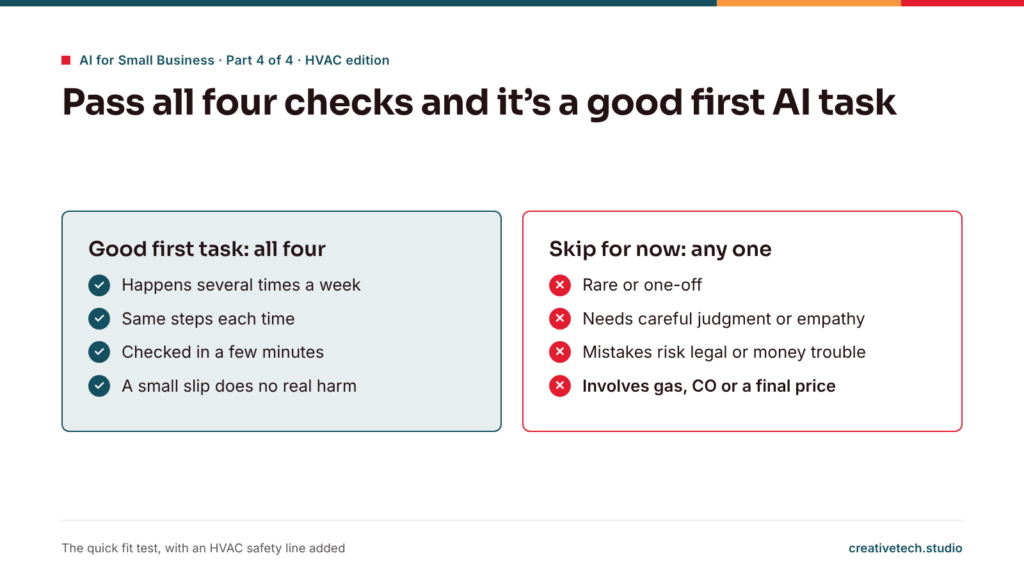
A task is a great first candidate if it:
- Happens several times a week
- Follows roughly the same steps each time
- Can be checked in a few minutes
- Won’t cause real damage if AI gets something slightly wrong
Skip it (for now) if it’s rare, needs careful judgment or emotional sensitivity, or a mistake could create legal, financial, safety or reputational trouble. For an HVAC company, that means anything involving gas, carbon monoxide or a final price stays with a person.
The payback math (it takes two minutes)
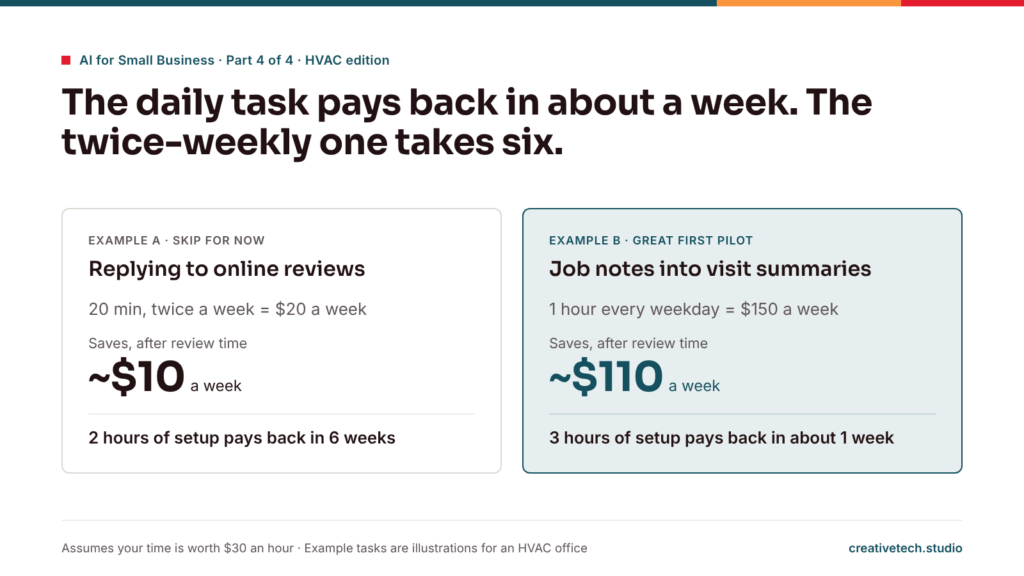
The subscription is usually the cheap part. Your real cost is the time spent setting up and reviewing. Here’s how to check whether a task pays off, assuming your time is worth $30 an hour:
- What it costs now: minutes per task × times per week × hourly rate.
- What AI saves: that cost, minus the time you’ll spend reviewing AI’s work.
- Break-even: setup time cost ÷ weekly savings.
Example A: replying to online reviews. Say it takes 20 minutes, twice a week, so about $20 a week. If checking and personalizing AI’s drafts still takes 10 minutes each time, you save about $10 a week. Two hours of setup ($60) takes six weeks to pay off. Fine to do eventually, but not a great first pilot.
Example B: turning technicians’ notes into customer visit summaries. Say the office spends an hour every weekday cleaning up job notes into clear summaries and tune-up reminders, so about $150 a week. If reviewing AI’s drafts takes 15 minutes a day, you save about $110 a week. A few hours of setup pays for itself in about a week. That’s the winner.
The best first AI project isn’t the flashiest one. It’s the boring task you do every single day.
Run a small pilot
- Write down your time leaks. The morning voicemail pile, the estimates that never got a follow-up, the job notes waiting to be typed up.
- Pick one task that passes the fit test.
- Note your baseline: how long it takes now and how often it goes wrong.
- Choose a tool that plugs into what you already use, like your email, calendar, accounting or service software.
- Decide who checks the output before it reaches a customer.
- Test it for two to four weeks, ideally before your busiest season, then keep it, tweak it or drop it.
AI or a new hire?
AI is a great first move for work that’s repetitive, low-risk and quick to check. A person is the right call for work that needs trust, accountability, complex judgment or new expertise, or when the workload is growing for good.
In the trades, that line is clear. AI can’t diagnose a cracked heat exchanger or reassure a family with no heat in January. But it can take the paperwork off the plate of the people who can. Often the answer is both: an office manager or technician who uses AI well can get far more done than either one alone.
The bottom line, and the series
Over these four parts, one message keeps coming up: you’re not behind. Most small businesses are just starting. The tools are affordable. Owners with no tech background are getting hours back every week. And a company like Rearick’s, with nearly 90 years of hard-earned trust, doesn’t need to become a tech company to benefit. It just needs to hand off the busywork so its people can do more of what they do best.
Pick one boring, daily task. Run the two-minute math. Start this week.
Thanks for reading the series! Follow for more practical AI for small business, and share in the responses: which task passed your payback test?
Missed a part? Part 1: You’re Not Behind on AI · Part 2: These Small Business Owners Got Hours Back With AI · Part 3: The Small Business AI Starter Kit
Inspired by Perplexity, “How to use AI in a small business” (Aug. 18, 2026). https://www.perplexity.ai/hub/blog/how-to-use-ai-in-a-small-business. Business details from rearicksnwi.com.
Medium publishing notes (don’t publish this section)
- Before publishing: Confirm Rearick’s is OK being named. If they can share a real time estimate for a task (like writing up job notes), swap it into Example B for a stronger story.
- Title: How to Tell If a Task Is Worth Handing to AI: The Simple Math, Worked Out for an HVAC Shop
- Subtitle: Set the italic line under the title as the subtitle.
- Tags (pick 5): Small Business, Artificial Intelligence, HVAC, Automation, Productivity
- SEO title: Is It Worth Automating? AI Payback Math (HVAC Example)
- SEO description: Starter prompts, a quick fit test and simple payback math, worked out for a local HVAC company, to help you pick a first AI task.
- Canonical link: If it ran on creativetech.studio first, import it or set the original URL in advanced settings.
- Prompts: Format each starter prompt as a code block (three backticks) so readers can copy it.
- Featured image: A clipboard of job notes or a calculator beside a service invoice.
- Graphics: Your payback math graphic uses the same numbers. Update the card labels to “Review replies” (A) and “Job note summaries” (B) if you want it to match.
- Pull quote: “The best first AI project isn’t the flashiest one…”
- Series: Link each title in the “Missed a part?” line once all four posts are live.
- Read time: About 7 minutes.