
Goal-Line Stand: The Veto-Session Explorer
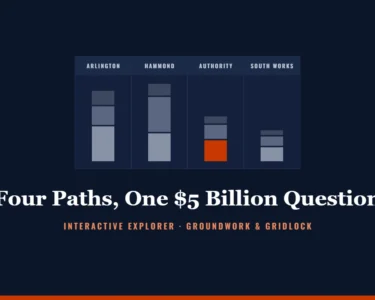
Three months after the Bears called Hammond their “sole focus,” NFL and Bears leaders met Illinois lawmakers and Illinois got back in the game, with a proposed stadium authority, a six-day veto-session clock and a lakefront wildcard at South Works.
My read: the leverage worked. Illinois is back at the table
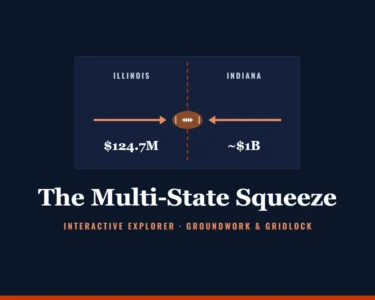
When Illinois’ spring session ended May 31, 2026 with no stadium bill becoming law (the House and Senate each passed a different one), Indiana looked like it had won outright. Lawmakers in Indianapolis had already enacted House Enrolled Act 1292 in 2025 and Senate Enrolled Act 27 in February 2026, establishing the Northwest Indiana Stadium Authority and roughly $1 billion in public support alongside a $2 billion private Bears contribution.
After the Bears’ board voted to advance the Hammond project and soil testing began at Wolf Lake Terminals in late June, President and CEO Kevin Warren said on Aug. 13: “Our sole focus at this point in time is working on a world-class stadium and mixed-use development in Hammond, Indiana.”
Wolf Lake carries real exposure: the research estimates a $100M+ foundation premium, and federal wetland rules give regulators strong grounds to favor the Bears’ own dry 326 acres in Arlington Heights. In early November, NFL Commissioner Roger Goodell, Chairman George McCaskey and Kevin Warren met Illinois legislative leaders.
In August it was “sole focus.” By Nov. 6 it was “productive dialogue with both leadership teams,” while Indiana signaled its patience has limits.
Nov. 6: Talks With Illinois Leaders & Indiana’s Response
Active LeverageOn Nov. 6, after Commissioner Roger Goodell, Chairman George McCaskey and Kevin Warren met Illinois legislative leaders, the Bears said they are still “finalizing due diligence details across two sites in the Wolf Lake area” and “expect productive dialogue with both leadership teams.” Gov. Braun’s office: “it is nearly time for the state to shift its energy and resources to the next opportunity.”
How the Public Stadium Authority bypasses the $124.7M Cook County tax deadlock
After the Bears bought the racetrack in February 2023, the Assessor reset it to about $197M and the Board of Review set $124.7M, about $8.9M a year in taxes. The Bears appealed for $60M. That fight left the roughly $5B campus plan without tax certainty.
What about the 2024 tentative deal?
Illinois Public Stadium Authority (Nov 2026 Breakthrough)
Tax-Exempt VenueThe Bears would pay to build the stadium, a city-created authority would own it, and public money would go to roads and infrastructure. Because the public owns it, there’s no property tax on the stadium. No bill text is public yet.
Reported near $855M for roads and infrastructure; final numbers depend on the bill.
Surrounding private development would still be taxable; lease terms and any payments to schools aren’t public yet.
Six legislative days in Springfield versus Governor Braun’s Indiana clock
Illinois’ 2026 fall veto session spans only six scheduled floor days split across two three-day blocks, culminating on December 3. The first block (Nov. 17–19) passed with no movement on a Bears bill. Rep. Kam Buckner says it’s “on track” for Dec. 1–3, while Indiana signals its patience has limits.
Nov 20–30 Recess: The Closed-Door Drafting & Compromise Window
Now (as of Nov. 26)Between the two floor blocks, negotiators must reconcile three sticking points before lawmakers return on December 1: how much state money goes toward roads, sewers, and rail upgrades; what replacement payments local Arlington Heights school districts receive once the stadium leaves the tax rolls; and whether Chicago (or South Works) qualifies equally under site-agnostic authority language.
Creates a path to a stadium authority, which would answer the Bears’ main Arlington Heights tax worry. Reports say the plan could apply to Chicago sites too.
My read: Indiana would have to decide whether to add protection against the research’s estimated $100M+ foundation and cleanup costs, or risk losing the Bears to their own dry land in Cook County.
The South Works wildcard: a site-agnostic pitch with unverified price tags
As Springfield’s stadium-authority plan took shape, developer Related Midwest pitched a domed Bears stadium and entertainment district at the former U.S. Steel South Works site on Chicago’s Southeast Side, near 87th Street and Lake Michigan.
Reports put the site at 200 to 440 acres, next to the planned quantum campus. Related says it would partner with the Bears rather than sell them land, and argues Illinois’ plan could work for any site.
A pitch isn’t a plan. Unlike Arlington Heights, where the Bears own 326 acres, or Hammond’s enacted law, South Works is a developer proposal the Bears haven’t endorsed, with no public price and no stadium transit or utility budget. It’s former steel-mill land, and the research flags long-term environmental monitoring as an unpriced risk.
U.S. Steel South Works (87th St & Lake Michigan)
Developer PitchFormer steel site reported at 200 to 440 acres, pitched by Related Midwest as a partnership. Near Metra Electric and CTA, but no Bears commitment, no public budget, and the research flags long-term environmental monitoring as unpriced.
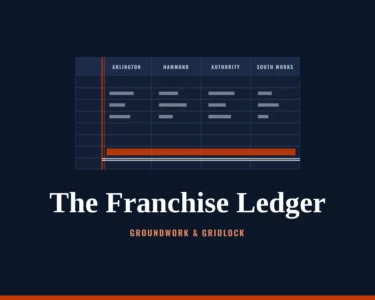
| Diagnostic Parameter | Indiana (Hammond / SEA 27) | Illinois (Arlington Heights) | Chicago Wildcard (South Works) |
|---|---|---|---|
| Site Control & Acreage | Due diligence on two Wolf Lake-area sites (Lost Marsh and Wolf Lake Terminals); Indiana’s authority would buy the land. | Bears-owned 326 acres purchased for $197.2M in Feb 2023; team’s stated focus inside Illinois. | Controlled by Related Midwest (200-acre core / 440-acre property); no Bears endorsement. |
| Public Financing & Tax Model | About $1B in public money (ticket, hotel and food-and-beverage taxes plus district capture) with a $2B Bears commitment. | Bears pay to build; a city-created stadium authority owns it (no property tax); infrastructure reported near $855M. | Unpriced publicly; Related Midwest pitches site-agnostic Public Stadium Authority eligibility under an undefined PPP. |
| Engineering & Environmental Friction | High risk (research): slag and peat, an estimated $100M+ for deep caissons, 200 ppm / 10 µg/L lead benchmarks, and Section 404 LEDPA review. | Low physical risk: dry land the research describes as clay, normal foundations, no wetland permit. | Unpriced (research): former steel-mill land with long-term environmental monitoring. |
| Transit & Readiness | Monon Corridor rail branch opened Mar. 31, 2026 (no stadium rail link announced); I-90 ramps; the Bears’ survey describes 15,000 tailgate spaces. | Adjacent Metra UP-NW commuter rail line (requires station/rail adjustments included in $855M request); dry site ready upon tax deal. | Metra Electric (87th St) & CTA access nearby; docks/water taxis unbuilt; internal stadium roads and crowd utilities unbudgeted. |
| Executive Leverage & Deadline | Braun’s office: “nearly time for the state to shift its energy and resources to the next opportunity.” | Talks with Illinois leaders reopened in November; a vote is hoped for Dec. 1–3, with no bill text yet. | Gives Illinois a lakefront fallback; the Bears haven’t commented. |
What decides the goal-line stand
Illinois neutralized its biggest flaw
By moving from tax appeals to a publicly owned stadium with no property tax, Springfield would give the Bears the certainty they wanted, if a bill passes. Details could change once one is filed.
Enacted statute vs. draft outline
Indiana still has the edge on paper: SEA 27 is signed law. But the research’s estimated foundation costs and Section 404 review make Wolf Lake the harder build.
Double-rejection remains the tail risk
The research’s tail risk: if Springfield misses Dec. 3, Indiana moves on, and federal review goes against Wolf Lake, overplaying leverage could leave the team with neither state.